Search

Monthly Archives: June 2021

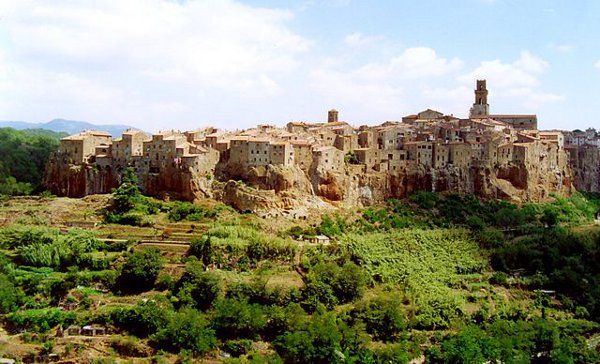
Pitigliano is a typical village of the Maremma, the only one of its kind for the distinction of being built entirely on a tufa rock, which makes it one of the most interesting places of the tuff.


Also known for the traditional feast of "Torciata of St. Joseph" in which, burning a puppet symbolic bids farewell to winter, the country over the years has become an important tourist destination of the Maremma.


The territory has been inhabited since very ancient times, as it can be easily proved by many finds of Etruscan origin, as the necropolis and the vie cave, excavated in the areas surrounding the village, Legend has it that the town was founded by two young , Petilio and Celiano that, escaping from their city after stealing an important object decided to take refuge in this part of Tuscany, founding a new country.


Currently, recent archaeological excavations, it appeared that Pitigliano was home to prehistoric appropriations already during the various phases of the Bronze Age (2000 - 1000 BC). Later it became the seat of an important Etruscan settlement of which there are parts of walls and numerous cemeteries. The Etruscan name of Pitigliano is not known, perhaps it was Statnes (or Staties) which in Roman times became Prefecture and was called Pitigliano Statonia.Il name instead derives from the gens Petilia, an important Roman family who gave their name to different locations . Dall'862 begins the domain of the family Aldobrandesca which lasts until the end of the thirteenth century. In 1293, following the marriage of the heir of the family Aldobrandesca, Anastasia, with Roman Gentile Orsini, Pitigliano became a county of this family Guelph. Until the end of 1400 it became an important center for the Jews, so much so that in 1598 was erected a temple still exists. In the seventeenth County passed under the rule of the Medici and the first half of the eighteenth century became part of the Duchy of which follow the fate until the unification of Italy.


The old traditions and customs of the Tuscan village are told in museums that have been set up: the Museum of Civilization Giubbonaia, which collects antique tools used in the country and houses the Museum of Palazzo Orsini, the Civic Museum and Archaeological Museum and Finally, the Open Air Museum "The City of the Living, The City of the Dead", dedicated to Etruscan history in the area.


Pitigliano is very rich in monuments and buildings that tell the story, walking through the village you can in fact meet the imposing Cathedral, built during the sixteenth century and dedicated to Saints Peter and Paul, the Church of Santa Maria, formerly named San Rocco, the Sanctuary of the Madonna delle Grazie, Palazzo Orsini, the Fortezza Orsini and finally the Monument to the Progeny Ursinea, consisting of a mass of stone with the family coat of arms surmounted by a bear arms.


Just outside the town is the Jewish Cemetery appointment. In the Ghetto Synagogue, built in 1598 has recently been restored and in adjacent rooms was built a Museum of Art and Jewish Culture. In the alleys underlying develop various rooms dug into the tuff: the ritual bath, the kosher butcher and the wine cellar, the oven of unleavened bread, all recovered and can be visited. "


Appreciable is also the DOC wine "Bianco di Pitigliano" and "Red Sovana."


To savor the sweets, the so-called "Eviction" in the form of small sticks with honey and nuts that in the folk tradition, shape recalls the stick with which he was knocked on the door when authorities performed eviction.

https://tuscanysea.com/backoffice/immagini/tuscanysea.com/31-17-5-2013-11-44-451.jpg https://tuscanysea.com/backoffice/immagini/tuscanysea.com/31-17-5-2013-11-44-452.jpg

by Valentina

Uncertain is the origin of Pisa, there are many theories about the foundation of this city in any case one of the oldest in Italy.

The plain on which it stands, which stretches from the slopes of Mount Pisano to the mouth of the Arno, was characterized by swamps, and the mouth of the River formed a large bog, encouraging a natural shelter for the boats and the birth and development of the city.

Dionisio Alicarnasseo Pisa describes how rich and flourishing, by the time they arrived the Pelasgians.

Cato, in his Origins, speaks of it as one of the oldest cities and Pliny in his Natural History attributes the foundation of the city to the Flats Alfei Pelasgians, commanded by Pelops, about three centuries before the Trojan War. Even Solinus says: "Who does not know that by Pelops in Pisa?". Virgil claimed that Pisa, of Etruscan origin, sent a thousand men to the aid of Aeneas, as he passed in Italy, after the destruction of Troy.

Strabo adopts two hypotheses, attributing the foundation is to Tarconte, the main

exponent of Etruscan mythology, both Pisei of the Peloponnese which, in the siege of Troy, were commanded by Nestor.

According to these theories, the origin would be from 1600 BC to 600a.C, the oldest if it relates to the Pelasgians, more recently, in relation to the Ligurians or Etruscans. All of these assumptions are based in each case on the writings dating back to a much later period, therefore, as to the reliability, we must admit that becomes somewhat problematic. "As may be inferred from smoke fire, only one draws the certainty of very remote antiquity to our city" as commented Tronci about the foundation of Pisa. Given the structure of the swampy territory also archaeological remains have never been so numerous and consistent to debunk or prove one of them.

The fact is that the city was built at the mouth of the Arno river close between this and the Serchio surrounded by wetlands that extended throughout the present plain.

He had various names, from a primitive to a later Teuta Alfea, but the present name derives from the Etruscans, who Pise, with the meaning of the mouth, indicating the probable scattered nuclei that formed as a whole, the city, and this would also explain the Latin plural of the title taken following: Pisae.

The core began to develop in particular thanks to the port and trade via mare.Difficile is also locate the exact spot where had to be the port of Pisa. Roughly one wants to just north of Livorno, the area now identified with Calambrone and Pond, adjacent to the current practice in the port labronico.

With the passage of time, and perhaps because of the continual silting, the harbor had become so narrow that at times medioevaleeste assumptions and determine with certainty the location of the first settlement

it could be closed, and as it were fenced with chains to prevent the enemy could enter.

A nothing, however, this measure was used in 1342, when the Genoese, with a surprise move, before they could pluck up the chains and then occupy the port. The chains, then donated to the Florentines, to have formed along a prestigious trophy of war, and now are hung on a wall of the Monumental Cemetery of Pisa.

Del Porto and related trades very well versed Lucan and Livy, and so described it in verse the poet Rutilius Numanziano: "Portum quem fame frequentat Pisarum emporium divitusque maris". The prosperity came for the trade based mainly on grapes, wheat, spelled, and the timber that came across the Arno from the Casentino

Pisa supplied throughout the Mediterranean, and imported from the East.

With the Etruscan domination began to establish business with the rich hinterland that was headed to the flourishing Velathri, Volterra, further strengthening an already established industry.

This wealth of commercial thoroughfares brought Pisa to have relationships with all the major civilizations of the Mediterranean, also culturally enriching, and formandogli with the knowledge, experience and the desire for autonomy, the natural originality that has characterized throughout its history.

In the third century BC the incursions of the Ligurian became more and more frequent, and greatly hinder the maritime trade and undermining the stability and security of the inhabited. Pisa so he decided to go under the protection of Rome.

It became an outpost of the Capital and was a basic element in the war of Rome against the Gauls, the Carthaginians and the Ligurians.

The war between them and the Romans, which took place in the city at the mouth of the Arno lasted several years, and lived alternately, until the decisive victory Capitoline, in 180 BC Pisa became a Roman colony, with wide autonomy, and began their seaborne trade more consistently, although their prestige, inland, was increasingly overshadowed by the growing power of nearby Lucca, overlooking the plain which stretched in front of Mount Pisano.

Nevertheless, a few years before the birth of Christ, Pisa began to take shape urbanistically quickly becoming one of the most prosperous cities of Italy, especially thanks to the efficiency of its port.

The remains of Roman civilization are numerous and scattered throughout the urbanized core and its surroundings. The most important remains are still the ancient baths, commonly called "Nero's baths".

47 of the Christian era dates back to the landing of the Apostle Peter who managed to take land at the mouth of the Arno roughly in that area today is called S. Piero a Grado, there seems to have founded a church, where is the current Basilica, and converted such a Pierino which was later consecrated as the first Bishop of Pisa.

Another event of the period was the beheading of a Christian Torpete, St. Torpoint, venerated as a Saint in Provence Tropez.

A few centuries later began the barbarian invasions, the invaders raged throughout the peninsula, spreading death and destruction everywhere, but Pisa was not affected as Rome, indeed, it was probably then that he laid the foundations for its development increased. .

Thanks to the conquests by sea, to the fame acquired, the importance of maritime trade, Pisa, around the middle of the sixth century had favorable conditions under Byzantine hegemony of Narses, who succeeded to the Huns.

Lucca was the seat of the rulers, and even the Lombards, who followed kept it as the cornerstone, leaving, however, a certain degree of autonomy to the port city.

Between the end of the century and in the age to come, was built a protection zone around the urban core.

Since 774 the Franks were to gain power, and an episode to mention is dating 828, when Count Boniface of Lucca, under the command of a ship and the Pisan fleet, inflicted a crushing defeat on Saracens, who raging throughout the Mediterranean .

The work of constant defense of the Tyrrhenian coast and sea trade by the Saracens, as well as the embankment of the advance Arab, was one of the salient and most famous in the history of Pisa.

The power center of Tuscia was still probably Lucca, Florence began to grow but also to consider while Pisa tried to distance themselves as much as possible, increasing by sea's wealth and fame

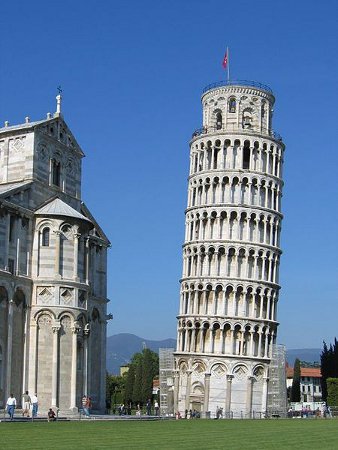
It seems that it is precisely thanks to this treasure that was entrusted to the architect Buscheto the task of starting the construction of the Cathedral in the great architectural complex known as the "Field of Miracles" and still is the symbol of Pisa.

More or less coeval to the Duomo is the construction of numerous Romanesque churches, which in some formal and structural characteristics are related to the greater monument, like the Church of San Frediano, the Church of San Michele degli Scalzi Church of San Zeno , the Church of St. Peter, the Church of the Holy Sepulchre, the Church of San Sisto and the Church of San Paolo a Ripa d'Arno, which is the most important constructive engagement for the city after the Cathedral.

In the second half of the century began to deteriorate relations with Genoa, which resulted with the conquest of the port of Rapallo, by Pisa, in 1075 and in a battle in front of the mouth of the Arno some time later.

On the death of Godfrey at the head of the feud Tuscan succeeded by his wife, the Duchess Beatrice, assisted by his son Godfrey "The Hunchback" and her young daughter Countess Matilde di Canossa, which for the death of both the joint, in 1076 he found himself only to manage one of the governments which was later considered among the most enlightened

In fact the firm, rather than a holy war, it was an economic character and power, not being very biblical messages in the agreement with the achievements at the cost of looting, death and destruction.

Pisa acquired a great importance, however, and although in Italy depended on the Emperor and was part of the Marquis of Lucca, was now the undisputed ruler of economic well-known throughout the Mediterranean having direct their fleets on the conquest of the most strategic for trade, which were later expanded.

Countess Matilda died in 1115, in Lucca, and began the decline of this city for the benefit of Florence, but began to glow with its own light the Maritime Republic of Pisa.

Came out recently from the most significant maritime conquest, one of the Balearic Islands, which in addition to the prestigious military value and paved the way for profitable trade and political relations with Aragon and Castile.

In 1118 the cathedral was consecrated by Pope Gelasius II, who confirmed the Archbishop of Pisa interference on Corsica, but exacerbating the conflict with Genoa.

Later, thanks to the intervention of Pope Innocent II, the two naval powers agreed in 1133 and are allied against the emerging Amalfi, in favor of the Emperor.

Pisa leaning always the imperial coat of arms, showing clearly its deep roots Ghibelline, though with the originality to maintain, with a skilful diplomacy, a certain detachment that would allow its autonomous action ........


It seems that it is precisely thanks to this treasure that was entrusted to the architect Buscheto the task of starting the construction of the Cathedral in the great architectural complex known as the "Field of Miracles" and still is the symbol of Pisa.

More or less coeval to the Duomo is the construction of numerous Romanesque churches, which in some formal and structural characteristics are related to the greater monument, like the Church of San Frediano, the Church of San Michele degli Scalzi Church of San Zeno , the Church of St. Peter, the Church of the Holy Sepulchre, the Church of San Sisto and the Church of San Paolo a Ripa d'Arno, which is the most important constructive engagement for the city after the Cathedral.

In the second half of the century began to deteriorate relations with Genoa, which resulted with the conquest of the port of Rapallo, by Pisa, in 1075 and in a battle in front of the mouth of the Arno some time later.

On the death of Godfrey at the head of the feud Tuscan succeeded by his wife, the Duchess Beatrice, assisted by his son Godfrey "The Hunchback" and her young daughter Countess Matilde di Canossa, which for the death of both the joint, in 1076 he found himself only to manage one of the governments which was later considered among the most enlightened

In fact the firm, rather than a holy war, it was an economic character and power, not being very biblical messages in the agreement with the achievements at the cost of looting, death and destruction.

Pisa acquired a great importance, however, and although in Italy depended on the Emperor and was part of the Marquis of Lucca, was now the undisputed ruler of economic well-known throughout the Mediterranean having direct their fleets on the conquest of the most strategic for trade, which were later expanded.

Countess Matilda died in 1115, in Lucca, and began the decline of this city for the benefit of Florence, but began to glow with its own light the Maritime Republic of Pisa.

Came out recently from the most significant maritime conquest, one of the Balearic Islands, which in addition to the prestigious military value and paved the way for profitable trade and political relations with Aragon and Castile.

In 1118 the cathedral was consecrated by Pope Gelasius II, who confirmed the Archbishop of Pisa interference on Corsica, but exacerbating the conflict with Genoa.

Later, thanks to the intervention of Pope Innocent II, the two naval powers agreed in 1133 and are allied against the emerging Amalfi, in favor of the Emperor.

Pisa leaning always the imperial coat of arms, showing clearly its deep roots Ghibelline, though with the originality to maintain, with a skilful diplomacy, a certain detachment that would allow its autonomous action.

In 1188 he participated in the Third Crusade. By the thirteenth century continued economic development of the thriving town, who tried to give himself an original legal-administrative decentralization of power.

The public body was headed by the Mayor, accompanied by the Captain of the People subjected to him, with the task of leading the militia and protect the people worse off by the nobility and the richer class.

The Captain of the People presided over the Council of Elders, the General Councils, the Council of the Thousand.


Soon resumed the bitter struggles with Genoa, more than anything else related to the domain of Corsica and Sardinia, and there were ups and downs between the two bitter rivals. Meanwhile in Pisa taking root authority of Count Ugolino della Gherardesca. He was able to connect their Ghibelline faith with the ideals of the powerful Guelph his son, Giovanni Visconti, Judge of Gallura, who joined him in the government of the Republic. This policy contrasted with the matrix that had always characterized the politics and ideals of the city, so that in 1274 the two rulers were banished from the city, which is why the Count Ugolino devastated the countryside, spreading terror, with the support of Charles of Anjou and the troops Lucca and Florence, and brought some victories against the militias of Pisa. These were later forced to surrender, yielding some castles to Lucca and the Florentines and accepting the return of Count within the walls. The greatest danger, however, came from the sea, in fact the rivalry with the powerful Ligurian city was accentuated more and more tragic and culminating in the crushing defeat of the Pisan fleet island of La Meloria, off the coast of Livorno, August 6, 1284 . For the Republic and his pride was a real defeat, so that we coined the saying, "Who wants to see Pisa go to see her prisoner in Genoa."

The terms of surrender were terrible and after the Meloria Pisa lost all importance as a maritime city and commercial Prisoners Pisa, Genoa, were thousands of them, and given the law that prevented women to remarry until her husband was dead, the damage a demographic that the city suffered, it was probably one of the main causes of future defeat.


Only the diplomatic skills that had always characterized the people of Pisa, and the experience acquired, managed to sustain the fortunes of the city, which you could not bend permanently although the decline was advancing inexorably.

The Elders of the Imperial Vicar appointed Podestà of Genoa, Uguccione Faggiola, which lifted the fortunes of the city, pushing even the conquest of Lucca.

In 1315 brought a great victory against the League Guelph, on August 29 in Montecatini.

But his ambitions were fatal to the power of the city and ended up seating itself dislodge the government Gaddo della Gherardesca.

He was able to bring peace with the most powerful cities in Tuscany, and also of his son married the daughter of Castruccio Castracani, Lord of Lucca, tightening so a link with the nearby town that always had been a bitter enemy.

Unfortunately Gaddo died in 1320, depriving the city of a presence that had been able to reconstruct important alliances, which however did not have followed.

If it was a period of internal restructuring, and notable works of fortification, with walls and towers for defense, however, was approaching a time rather negative politics.

Targeted by sea, the port and threatened almost inefficient dall'insabbiamento caused by the Arno, Pisa was surrounded by city traditionally rivals, who isolated it from the reference imperial detached itself more and more.


Collapsed so, the prerogative of Florence, the glorious maritime republic on 9 October 1409.

Pisa definitively lost its freedom, except for a brief parenthesis at the turn of the fourteenth and fifteenth centuries.

The political and economic decline is irreversible, produced a significant depletion of the great constructive engagement so that in the fourteenth century the only important religious construction was the church of Santa Maria della Spina, on the Lungarno Gambacorti, and in the context of civil Palace Gambacorti.

In sharp demographic decline, economically exhausted, but the city still retained all the cultural characteristics of a cosmopolitan city, so much so that in 1409 it was chosen as the site for a Council.

He began a new phase for the city, that of awe, never felt before.

The Florentine nobles aimed mainly to strengthen the defense of your domain building fortifications around the city, such as the complex of Stampace-Porta a Mare, the Citadel Old and New, the Bastion of Parlascio that would have been even designed by Filippo Brunelleschi.

With the advent of the Medici to the pinnacle of power lilies began, however, a period of economic recovery, social and even cultural, thanks to the Enlightenment ideals and development of the territory of the rulers.


This led to the end of the century, when the city, driven by the arrival of Charles VIII, resumed its independence, albeit supervised by the king of France.

Also promised their help to the independence of Pisa, the Duke of Milan, Emperor Maximilian of Austria, the Republic of Venice, in 1496 giving the support of his troops.

Pisa found himself again the protagonist, regaining many castles, but was at the mercy of the interests of three Allied powers who had designs on the city, and seeing the opportunity to excel, they abandoned to their fate.

The Florentines soon regained the lost positions, and girded siege in the city on the Arno.

The siege lasted several years, with several failed assaults, inside the walls they fought heroically, and florins were unable to have the upper hand, until, through a tentative agreement with the King of France and Spain, and with neighboring cities , failed to isolate both politically and materially Pisa, as with the siege were blocked all roads, including the Arno and other waterways


The new Grand Duke is also very dedicated to the development and the raising of the university, and he should be recognized a particular fondness for Galileo Galilei, who was appointed First Mathematician and Philosopher.

Cosimo II died just thirty-two years in 1621, leaving a serious gap in terms of personality that was not filled by any of the successors.

With Ferdinand II began the neglect of the town which, in 1630, was hit by the epidemic pestilence which decimated the population in the whole peninsula.

Only in recent years, the Grand Duke pointed to a cultural revival of the University, thus resuming a little 'personal prestige.

From 1670 he was succeeded by Cosimo III, who was certainly the most immobile of the Grand Duchy, now divided into fiefdoms and abandoned in a uniform policy and loose, the disinterest of the vertices of the domain.

A Gian Gastone succeeded by Cosimo III, who was the last of the Medici.

From 1737 took the reins of the Grand Duchy of Lorraine, of which the first was Francis II.

The situation in Pisa began to improve thanks to the sense of responsibility and industriousness of the new rulers.

Within the walls were made considerable improvements, and enthusiasm for the new rulers grew up, seen the renewed interest in the fate of the city and the countryside.


Following Cosimo founded the Office of the Rivers and Fossi, and he devoted much of interventions bonificadel territory and to initiatives to raise the social, political and cultural life of the city and its surroundings. In 1548 came the estate of S. Redness, expressed wish of Eleonora of Toledo, wife of Cosimo, while in 1560 it was started Navicelli Canal, which connected the mouth of 'Arno with the port of Livorno, as the grand-ducal city in the outlook would have to provide a forum merchant to complement the Livorno port of call. Also in 1571 a Pisan fleet, or rather Medici, participated in the victorious Battle of Lepanto against the Turks


As a result of power struggles that were upsetting the whole of Europe, the Grand Duke preferred to leave their domain, taking refuge in Germany.

Pisa was thus at the mercy of Bourbon-Parma, then under Elisa Bonaparte Baiocchi, and finally directly under the aegis of the French Imperial, which ended in 1814, with the defeat of Napoleon.

Restoration began with the return of Ferdinand III, highly acclaimed by the people.

A Ferdinand III was succeeded, in 1824, Leopold II, who distinguished himself who was also in the works of internal restructuring, but mainly in the reclamation and improvement of waterways and lines of communication with the opening of the railway sections for Livorno, Florence and Lucca, who came to revive

the function of road junction of great importance that Pisa had played since ancient times .. In 1846 also the capital suffered damages due to the earthquake that took the epicenter Lower Pisan Hills.

In the city began to pull air of rebellion, had formed numerous secret societies, the atmosphere was tense and certainly did not presage a period of tranquility for the vertices of the Grand Duchy.

After settling uncertain due to the Wars of Independence, February 27, 1859 Leopold II left Tuscany, and a year later there was a plebiscite for annexation to the Kingdom, which saw 12,049 voters in Pisa in favor of 12,285.

Thus began the modern phase of the city's history.

In the following years there was a radical transformation of the urban fabric with the birth of several buildings and the dismantling of many structures of medieval times which gave a new configuration to the city

The March 10, 1872 Giuseppe Mazzini breathed his last in this city where he lived for some time under a false name.

At the beginning of our century Pisa was one of the most active cities of Italy, both from an economic point of view that cultural

This led many industries, among which we distinguish the Saint Gobain, precious glassware still active, and the factory of Richard Ginori ceramics, was developed in the textile industry, in particular that of the cotton mill, and there were many craft businesses

They were the designers of equipment, brothers Antonio and give life to the airport in 1911, it began to increase its activities, both civilian and military.

During the Second World War, the city has paid the contribution of well-sad 1824 dead and many were damaged and destroyed buildings from the relentless bombardment to the damage he joined the overflowing of 'Arno of November 1944, which was yet another blow to the already disaster perpetrated.

The works of reconstruction began immediately, thanks to the spirit of revenge and the strength of will that has never left this town, and within a few years had been rebuilt the bridges destroyed by the Germans as the main structures damaged

Today, Pisa is a city with an economy geared towards many areas.

In the area of ​​Ospedaletto has developed an important, broad and diverse area industrial and artisanal

L 'Galilei Airport is undoubtedly the region's main

There are some barracks of the most efficient of Italy, and between the city and the coast, in the bolster, behind Tirrenia is situated Camp Darby, a logistics base of the U.S. Armed Forces, among the most important in Europe , which serves mainly as storage and refueling of U.S. troops stationed in Italy and other parts of Europe.

In the area of ​​Barbaricina, adjacent to Park St. Redness and the Hippodrome, are numerous stables and activities related to horseracing

It 'also important tourism, especially related to the influx in Piazza dei Miracoli, the recent discovery of relics in the ancient Roman naval port of Pisa and the summer season on the coast Pisano, with the many activities and tourist resorts of Marina di Pisa, Tirrenia and Calambrone.

Very active and efficient are the three hospitals of Santa Chiara and Cisanello Calambrone

They are to report the Military Applications Nuclear Energy Center, established in 1956, and the National University Computing of the National Research Council, which is present in Pisa with 13 institutes and 5 centers, more than specific importance that these structures play they also represent a significant source of employment.

The University of Pisa has some power at the national level that the rise culturally and moreover bring an economic benefit to the many students who flock daily or come to reside in the city.

It represents the real basis for relaunching Pisa, both from an economic point of view, that from a point of view and prestigious cultural

Thanks to the University who runs it together with the 'Municipal Administration, was created, and has been active since 1984, Palazzo dei Congressi, polo important city for the numerous international conferences and various events that in this modern and highly efficient headquarters are organized

With the arrival of numerous mercenary troops beginning in the pay of Florence, Pisa was able to slightly raise their own situation, regaining some of the castles strappatigli, especially with the help of the famous leader known as Giovanni Acuto.

As they had previously done with the Florentines, but the mercenaries proved to be very loyal to the interests of Pisa, which reported a heavy defeat at the Battle of Cascina, July 28, 1364.

The infighting between Raspanti Bergolini and tore more and more cities, already impoverished even by hijacking traffic of goods from Florence to Talamone, from 'political isolation and the loss of consistency in the maritime field.

It was the Gambacorti, who had previously driven to give a sigh of relief to the fate of Pisa and succeeded in getting agreements with Firenze, allowing a resumption of trade, so much so that he was appointed Captain General People's Defender and the Municipality of Pisa.

It was the only one able to use that ancient and cunning diplomacy, described above. Gian Galeazzo Visconti, Lord of Milan, plotted in the city at the mouth of the Arno, to counter the relations with rival Florence, and did so much that he hatched, October 21, 1392, murder of Gambacorti, bringing to power the D'Appiano . Gherardo d'Appiano, in 1399, "sold" to the Visconti the city of Pisa, with the lordship of Piombino and the islands, Elba, Montecristo and Pianosa, for 200,000 gold florins

https://tuscanysea.com/backoffice/immagini/tuscanysea.com/30-17-5-2013-11-42-181.jpg https://tuscanysea.com/backoffice/immagini/tuscanysea.com/30-17-5-2013-11-42-182.jpg

by Valentina

Piombino, located on the promontory of the same name, the capital of an ancient Italian state, a seaside town, home of the Etruscan metallurgy, heir to ancient traditions of classical and medieval, Piombino retains many architectural works in that past.

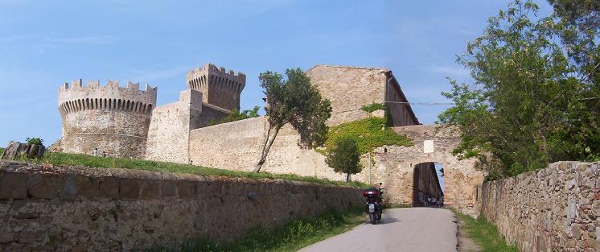
Receives a clear appearance by the Florentine Renaissance A. Look under the dynasty of Appiani lordship from 1399 and the Principality in 1589; domain of the Boncompagni-Ludovisi, was granted in 1805 by Napoleon's sister Elisa leaving tangible signs of his government almost to the nickname "Little Paris".

The ancient port of Falesia, of which we know from the fifth century AD today is the most important port-Tuscan passenger, as well as connected with the island of Elba and the Archipelago, even with Sardinia and Corsica.

A city to discover: art, sea, history, folklore and tasty cuisine, enrich this territory, which today sees tourism as a projection into the future, a bet on the future.

With its 31.5 Km "of coastline beaches, of which 22 Km sandy and rocky 9.5 reachable by both land and sea, with its mild climate, its crystal clear sea by the stunning backdrops, Piombino offers recreation and relaxation for all ages: from sports holidays, adventure and fun in nature and cultural tours that can be enjoyed throughout the year, each season has its wonders to discover - in spring and autumn, periods in which nature is more generous than scents and colors, the guest can discover aspects that often remain hidden from the summer tourists.

Beaches, tennis courts, skating, soccer, sailing, surfing, swimming, diving, horseback riding, boating at night, links to Elba, Corsica and Sardinia;


The sea, calm or turbulent centuries viewer of this land, now has its rightful place as leader. Intact, still in its primitive beauty, laps the shores of the promontory of Piombino, both north and south.

Including the archipelago and clearly visible from the coast on a clear day, as well as the island of Elba, the islets of Cerboli, which is 4 miles from Piombino, to Palmaiola completely uninhabited and not far behind him, which emerges as a cliff of triangular shape.

The archipelago enjoys a mild climate, ranging from 7 ° to 30 ° C, with winters characterized by erratic rainfall and frequent droughts in summer the winds are predominantly from N and NW SE SW, while the ocean currents coming from the southern coast of the peninsula.

The promontory of Piombino, has a shape generally rocky, which are not easily accessible has preserved the look, despite some unauthorized actions in fishing operations and the neglect of tourism.

In the marine environment in the area of ​​Baratti and San Vincenzo, after the first stretch of sandy bottom, you will encounter rocky formations that form a structure at greater depth coralligenous. Interesting phenomenon manifests itself in this area, thanks to the contribution of the pit nutritional Hot that comes from the hinterland and that converges in this point seasonally favoring the influx of fish of particular value, such as sea bream, sea bass, sea bream and paraghi etc.., Determining ideal conditions for reproduction.

On the south side of the coast of Piombino the seabed is sandy, muddy and debris. At about 40 mt. depth are funds coralline algae. The fish are typical southern habitat that makes this typical environment from a ecological point of view.

As you can see, the seabed had to achieve to human behavior clumsy and superficial, while managing to preserve its integrity and, as, returning to the man also some traces of its ancient civilization. They are in fact numerous archaeological remains found in the waters of the Gulf of Baratti, some are still being studied, others are kept in the collection of Populonia Gasparri, others have gone missing. Also of importance is the finding of a Roman ship, in 1957, about 120 m. from the shore, at the church of San Cerbone. Emerged from the sandy bottom at about 4m. depth, along with some items likely belonging to the ship's cargo.

In the central part of the gulf, however, at about 20 meters. deep, was discovered a Roman shipwreck in good condition, unfortunately ravaged by looters. It was possible to retrieve a jar of iron stored in the Palazzo Civico di Piombino, not in good condition.

In the south east of the promontory of Piombino, in the Gulf of Salivoli to the west, two amphorae have been found intact at about 20 m, along with other pottery fragments. In the stretch of sea off the Long Beach have been unearthed pottery fragments of indeterminable age, up to over 30 m. of depth.

A large creek of Cala al Piccione, always in the area of ​​Long Beach, was localized by some fishermen Piombino an Etruscan shipwreck, while, at the tip of Tonnarelle in 1832 was discovered the famous bronze statue of '"Apollo Piombino ", now kept at the Louvre museum in Paris.

Described the sea in its natural environment and its treasures, now we follow an overview of the beaches of Piombino, those north and south of the city and pathways needed to get there.

Piombino has its beaches, all different among themselves: sand, stones, rocks, landscapes with various frames, some in direct contact with the modern architecture of the city, such as the beach of Salivoli, some in contrast with traces of ancient buildings, such as Piazza Bovio, some at the foot of the slopes of vegetation, such as the one in Via Amendola, Porto Louse, Calamoresca and Long Beach. These are the main goals of the citizens of Piombino, young people, older people, mothers and children who enjoy days of sun and fun.

The coast to the south and north of Piombino is reached along the road out of the city, following the directions of the signs that lead, on the one hand and on the other to Rome to San Vincenzo. Opting for the detour to Rome, the road leads south to the coast. It can be accessed by following the paths of engagement along the main road from this branch out one after the other, marked by signs with the names of the resorts to which they lead and that is Perelli, Carlappiano, Mortelliccio, Carboniferous and Torre Mozza.

Through all areas of the countryside and come to the sea bore by short stretches of pine forest. The tourist facilities in this area consist of camping sites, residences, shopping malls, bars and restaurants directly on the beach, horse riding and beach sports, surfing and boat hire

And 'the ideal place to live away from the city, in an area where nature blends with discrete tourist sites.

Following the road signs instead of Piombino exit for San Vincenzo, walk along a street lined with mild hills. After a few kilometers you will reach the turnoff for the left-Populonia Baratti. We are located in the ancient Etruscan homeland. The dense Mediterranean vegetation close to the wooded hills is rich in vegetation. Enchanted to admire the beauty of the landscape of this area, from the promontory on which stands Populonia dives look in incomparable bay of Baratti, a favorite destination of tourists in search of sea and traces of history. Very striking is the beach of Buca delle Fate, on the rocky cliff, accessible from the road that leads from Baratti to Populonia. The organization of the tourist area includes restaurants, bars, riding, boat rental, taxi service for the sea and a chance to visit the coast, following the ways of the Etruscans surfing, surf school and other activities. Not least are the archaeological sites of Baratti leading to an increasing flow of visitors each year, along with the archaeological museum and the highest part of Populonia where visitors flock in small souvenir shops.

Back on the main road, past the junction for-Populonia Baratti, we continue observing the direction for St. Vincent. After a few minutes we are flanked by pine forest of Rimigliano that follows the path for about 4/5Km.La Rimigliano beach is located behind the pine forest and follows the perimeter of the coast immediately after the beach Torraccia. Bathers lovers of afternoon siestas

https://tuscanysea.com/backoffice/immagini/tuscanysea.com/29-17-5-2013-11-38-01.jpg https://tuscanysea.com/backoffice/immagini/tuscanysea.com/29-17-5-2013-11-38-02.jpg

by Valentina

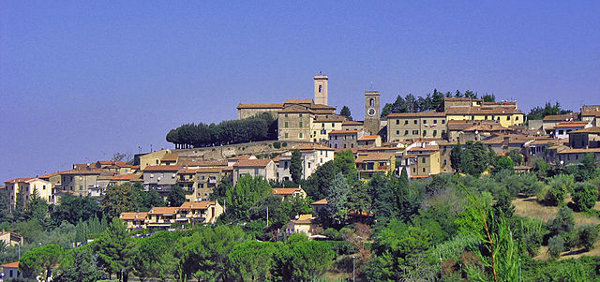
Montescudaio The name comes from the Latin Mons Mons or Scutarius Scutaris, but the settlement is much older, dating back to Villanova, in the early stages of the formation of the Etruscan civilization. In a tomb near the village was found a cinerary urn of the ninth or tenth century BC for its exquisite and unique decoration with plastic figures on the cover is a unique and very important at that time. It is located, along with other furnishings, the Archaeological Museum of Florence.

The first historical documents are found around the year one thousand, when the "castle", ie the fortified village surrounded by walls, belonged to the Gherardesca. At that time the accounts settled permanently in Montescudaio, where they built a palace or a fortress and, since the fourteenth century, gave rise to its own branch of the family, which took its name from the village: the accounts of Montescudaio. It was, apparently, a race particularly bold and impetuous, a descendant of the John Della Gherardesca for his lack of athleticism was called "Cockroach". Already in 1305 the children of the Cockroach were denounced because they had made raids and cattle rustling in the territory of Volterra. In 1345 the Montescudaio, allied with the Republic of Pisa and it has appointed vicars in Maremma, were protagonists of a dramatic episode of treason: with forged letters led the castles of their jurisdiction, Montescudaio, Guardistallo, Bibbona, Rosignano, Vada and to Fauglia rebel against Pisa itself. Of course, the revolt was quelled because not long after Montescudaio were again accepted in Pisa, where he later played a secondary role in the struggle for power between the factions in the city. In 1395-96 revolted again against the Republic of making raids into the territory of Pisa, now backed up from Florence.

In 1406, when Pisa with the whole countryside was sold to Florence, the accounts were quick to get credit in this city, and were re-appointed vicars in Maremma. But the inhabitants of Montescudaio failed on this occasion to get rid of them, submitting voluntarily to the Florentine Republic from which were allowed to form in the Municipality. In January 1406, in fact, a delegation of four men Montescudaio, along with another of Guardistallo, left for Florence to treat submission. The representatives not only obtained permission to form themselves into the City and to draw up their own statutes, but also the ouster of the accounts, to which was given the ban to enter the castle of Montescudaio.

The territory of the municipality was made up of small private property and large communal areas - mostly pasture and woodland - which were exploited collectively. The inhabitants of Montescudaio could graze the cattle and cut wood for their own use on payment of a sum fixed by the statutes and payable to the chamberlain of the community. Hunting and fishing were free.

The statutes - would apply both to Montescudaio for Guardistallo and from 1414 also for Casale Maritime - regulated the election of the consuls (the highest government office, whose names were extracted from a bag), and directors, elected by voice. The statutes defined the various municipal offices and establishing their penalties and fines, which, in addition to the fees for grazing, were one of the highest revenue of the municipality. He had to pay any kind of transgression: play ball in the streets, swearing, do filth in the country, send the cattle to pasture outside the times and the boundaries established, but it could also be fined a worker who, for example, had rented a ground Municipal and worked little or evil.

The statutes regulating the life of the villagers during the seasons:

in March, had an obligation to make the garden from May the "roads" had to take care of the roads, in September you could hire the municipal guards to watch over the vines and figs. It also stipulated that the number of animals that each family could send on the pasture, it regulated the slaughter and sale of meat and decreed that the stubble and the acorns were reserved for the pigs, the most important animals to feed family could also circulate freely in the country.

As regards the rules of hygiene, you should water the animals in the source reserved for men and the inhabitants were obliged to sweep the front door at home, especially on Sundays. When the dirty water were poured into the street had to warn in advance, particularly at night you had to shout three times, "water" before turning something on the pavement.

The community suffered several invasions and devastation. In 1447 it was attacked and sacked by the troops of Alfonso of Aragon, King of Naples, at war with Florence. The invasion, among other things, was made possible by another betrayal of accounts of Montescudaio who had allied with Aragon thus facilitating the fall of the castles maremmani. In 1478 Montescudaio was invaded by Ferdinand of Aragon, son of Alfunso, and a year later, was sacked by the same Florentine troops, start to regain it. Following negotiations, the people least able to avoid the fire of the castle.

The age of the City ended in 1648, when the Medici made the whole area a feud that was granted to the Marquis Ridolfi of Florence and they confirmed again by Lorraine in 1738. The land returned then to be owned by "Really, sir," the hunting and fishing privileges were again the feudal lord. The Marquis Ridolfi forbade her by a decree of 1778 in all its territory, triggering a strong protest of the population.

Another part of the woods was bound by the Regie Ferriere Magona in Cecina, plant for the smelting and working of iron, which had the exclusive right of exploitation of the surrounding forests for firewood supplies needed to run the ovens.

The seventeenth and eighteenth centuries were therefore quite difficult for men to Montescudaio. The feuds were abolished by the Law of 1749, introduced by Lorraine, and from 1770 began to Montescudaio sales and rent concessions of land is grand ducal and municipal sphere of agrarian reform of Grand Duke Peter Leopold. The reform proposed a new and more widespread distribution of land to encourage a more rational and intensive cultivation, aided by new agricultural techniques. It is in fact reached this purpose, but not to benefit the people of the castle, but by creating a new class of landowners, who were working in the fields day or sharecropping. The inhabitants of Montescudaio had tried to oppose the privatization of communal land by sending a petition to the administrator of Pisa, in which they expressed their concern that the land could end up in the hands of a few landowners who could ask for excessive payments for grazing, cultivation and wood or deny them altogether. The population would have been so put "the hook in the throat." The petition was rejected as groundless, but in fact more than half of the communal lands of Montescudaio was assigned to only two owners, Guerrini Montescudaio and Chancellors of Vincenzo Casale.

In 1846, the agglomeration of the oldest houses of the castle was destroyed by a violent earthquake. While the village, which extended south to the valley, he was saved in large part, on top all houses collapsed and the church of Santa Maria, just enlarged and adorned, was ruined. Eight people died under the rubble.

The Grand Duke in his visit to the earthquake-hit areas in Montescudaio also stopped allocating funds for reconstruction.

Another earthquake struck the town in 1871 and completely destroyed what was left even partially standing, such as leftovers of the old palace of Montescudaio.

In the nineteenth century there was a notable increase in population, even if the economic situation remained difficult (in 1784, there were 434 inhabitants in 1825, 707 in 1841 and 1,008 in 1901, 1,931). After the unification of Italy the taxes were very heavy, even those with low incomes and low revenue of the municipality. The number of "Les Miserables" increased considerably. We recorded movements between countries of manpower, in search of work, including seasonal. The activity was predominantly agricultural and the main products were, as for centuries, the oil and the wine. At the beginning of the twentieth century the wine was an important product in the provincial trade.

Montescudaio has reached the maximum of 2,880 inhabitants in 1927. After World War II occurred on demographic collapse due to migration to the new industrial and commercial centers along the coast, Cecina and Rosignano (Montescudaio in 1951 numbered 2,010 inhabitants, while in 1967, only 1,298). The Municipality has still managed to offset the loss with the new settlement of the forint, location on the border with Cecina, and the nearby industrial area of ​​Poggio Gagliardo. So last census occurred even a slight increase in the number of inhabitants. There remains the problem of an aging population: 40% of residents has more than 60 years.

In addition to trade and industry in Poggio Gagliardo, Montescudaio has been a significant development in the field of tourism with new residential complexes along the road to Cecina.

For 19 years Montescudaio produces a DOC wine, red and white, which can be purchased in the ten farms that form the consortium of Montescudaio DOC wine (made from grapes of Sangiovese, Trebbiano, Malvasia, Canaiolo and Cherry red for red; Trebbiano, Malvasia, Vermentino and Canaiolo white for white. production of 6,000 hectoliters per year.

Taken from the Guide to the Val di Cecina, curated by Susanne Mordhorst, New Image Publishing

https://tuscanysea.com/backoffice/immagini/tuscanysea.com/28-17-5-2013-11-35-391.jpg https://tuscanysea.com/backoffice/immagini/tuscanysea.com/28-17-5-2013-11-35-392.jpg

by Valentina
Montenero

The Sanctuary of Montenero


Montenero, placed on a hill overlooking the sea and the port of Livorno, is among the hills of Tuscany's most famous especially due to its famous shrine dedicated to Our Lady of Grace. It is said that a shepherd cripple, around 1345, he found a miraculous image and asked to be transported on the hill of Montenero. Heard the voice of the shepherd did as he was told and got to the top of the hill he found himself cured. Since then, that image of the Madonna has never ceased to be a source of devotion and grace for all those who are turning and the Sanctuary that is born is a place of pilgrimage and visits by a large number of people.


Origins

The origins of the shrine dates back to May 15, 1345, the feast of Pentecost, when, according to tradition, a poor crippled shepherd found the miraculous image of the Virgin Mary and following inner intuition led her on the hill of Montenero, a place already known as a refuge of brigands and considered for this dark, gloomy ... the "mountain of the devil."

Beyond the many legends surrounding the history of the discovery of the image of the Madonna, which critics attributed instead to a certain Jacopo di Michele Gera said, it seems that image appearance in Montenero following a revival of religious fervor, around to 1341. In this year of the inhabitants of Livorno, then little more than a fishing village, would organize a cult of self-sacred images painted recently, however, opposed the ecclesiastical authorities intimated that the cessation of worship, and the disappearance of its images. We can not exclude that in front of this hostility, the image was hidden and later found near the shore of the river Ardenzo'''', from that zealous pastor who took her to the top of the mountain in order to entrust almost certainly the custody of some hermit .

The history

The fame of the miracle spread quickly, because of the many graces made by the Blessed Virgin and the pilgrimages begin with they are on the increase for the small chapel that houses the Madonna. Already in 1380 work began to expand the chapel and premises that served to protect the pilgrims. For the first custodians of the shrine, almost certainly the friars tertiary, followed in the cases of the Jesuits (1442-1668) and Teatini (1668-1792) then indicated as the most qualified to perform the service in the Sanctuary. In fact, in 1720, work began on the Theatines expansion of the Sanctuary which was finished in 1774. During this time, Our Lady of Montenero worked some miracles in favor of the entire city including the one in 1742 when the city was devastated by an earthquake and once again rescued by his patron and his image which was brought to the city and placed in front of the Collegiate. In Livorno that miracle was never forgotten much that is renewed every year the hope that the Livorno made to Our Lady "... to fast in perpetuity January 27, of no dancing, no masks, to assist in the Collegiate same all'annua function ... thanks.'' In 1792 the sanctuary was entrusted to the Benedictine monks of Vallombrosa which are currently the custodians.


Montenero is among the places of Tuscany's most famous especially due to the presence of the Sanctuary. Set on a hill at 300 m asl, Montenero has a wide horizon of the sea and land area of ​​outstanding beauty. Awesome views open before the eyes of observers. From here you can look down to the rock of Meloria, memorable for the betrayal of Count Ugolino (1284) and the famous battle between Genoa and Pisa, but also the plain with its Port of Livorno and that of Pisa. To the south you can see the island of Elba, Corsica and Sardinia: its wonderful sunsets. The name "Montenero" is due to an old famous saying this resort mountain dark, perhaps because covered with jagged ridges and infested with robbers who, in all probability, here waiting for the arrival of ships to which the assault. Montenero joined Livorno with a bus and a funicular that goes up to the square in front of the Sanctuary. The upper square was created by monks in the last century almost atrium discovered the Sanctuary itself. On one side stands the facade of the church, across the street Famedio: chapels that contain the mortal remains of large Livorno such as Guerazzi, Marradi, Meyer, Castles, Farms and a plaque in memory of Pietro Mascagni and Amedeo Modigliani.

L '8th September the festival being felt in the pilgrimage of the locals which is uninterrupted and the shrine is lit up at night after night Marian procession from the Chapel of the Apparition at the Shrine itself.

The Chapel of the Apparition

Located just before the Carriage Square, is the place where the tradition dates back to the discovery of the image of Our Lady of Montenero by a shepherd. Built in 1956, the larger and more beautiful than the pre-existing in the same place where he was the'' Chapel "partially destroyed during the last war (1943).


Church

The Church in Baroque style, very charming and inviting to meditation and prayer. On the main altar stands the Sacred Image of Mary in a marble shrine surrounded by a golden halo. The image of the Virgin, attributed to the school of Pisa and in particular to Jacopo di Michele said Gera, is painted on canvas superimposed at the table. The Virgin with the red robe and blue mantle, is sitting on a pillow and around the head is the word "Ave Maria Mater Christi". The face is tilted toward the child who sits with her hands in her lap clinging to the mother's robe, holding a thread that binds the bird gently on the arm of Mary, as if to indicate that faith is like a thread that draws the salvation Christ which keeps us united devotion of Our Lady.

Other important works of art are the Dome of the Church and the Tele side altars. In the dome, restored in 1992, is represented in the Paradise feast for the highest glorification of Mary, crowned Queen of men and of angels. The painting, executed in 1773, is the work of the famous master Traballesi. In the wonderful scenery saints and angels appear with Old Testament characters: Adam and Eve, David, Daniel, Aaron, Moses, Samson etc. up to St. Joseph, St. John the Baptist, St. Anna S. Cecilia and other martyrs. The most important are the Tele instead of San Giovanni Gualberto, founder of Vallombrosa, in the second altar on the right. The Canvas by an unknown artist depicts the saint in prayer in the background of the heights of Vallombrosa, the feet with the abbey founded by him. Another Canvas, located in the third altar on the right, depicting the Assumption of Mary and is the work of Philip teatino Galletti. In the bottom of the canvas, in the center, there is a niche in which is guarded, well-preserved a crucifix which is assumed to have been originally in a cave in the place Hermit, overgrown cliff on the sea coast near Livorno. On the sides of the Virgin are represented the Apostle St. Peter and the S. teatino Andrew Avellino. Always Galletti is the painting of Our Lady appeared to St. Gaetano Thiene, and presented the Child Jesus was solemnly inaugurated in 1696 on the feast of the Name of Mary.

by Valentina
Meloria

An islet, or more exactly a rocky outcrop surrounded by cliffs above the water in the Upper Tyrrhenian Sea, nine kilometers long and two wide, in front of Livorno which is just a short distance to the sea: this is the Meloria, famous for the battle of August 6, 1284 which marked the great defeat of the Pisan fleet perpetrated by the Genoese. But the Meloria is also a place, from antiquity to the present, for the extraordinary landscape and nature, for morphological details that distinguish it. In this book, a famous explorer of the exotic seas of the Mediterranean and in particular, how Folco Quilici, a historic student of Marco Tangheroni as Olimpia Vaccari, a naturalist and Livorno, such as Gianfranco Barsotti, who Meloria and nature below the its sea knows all, we return to this place that belongs to the collective of the civilizations of the Mediterranean's most important aspects. The book also in the photographs of Fabio Jackdaw, for the emerged part, and William Cicerchia and Federico Fiorillo, for the submerged part, amazing images and highly suggestive.


Cursed meloria

Renzo Castelli

The defeat still burns with Genoa, seven centuries later. Maybe it's time to get over it ... I'm not rooting athlete nor traditions are often a little 'fake driven by tourism, to draw the very soul of a city. In the case of Pisa, his "pisanità." In a few cities, like this one, the story, and then the remote past, have left their mark so marked and conditioning. Pisa has too much memory - the Etruscan origin, the size of its navy - to forget. That's why even today the Meloria is not only the name of a battle ended in defeat, one of many that man has fought on land and sea, but it is the death of a city-state, the humiliation of its citizens. With the Meloria (1284) Pisa has lost her pride, dreams, royalty, and never will forget the lost power. The city-state he bowed his head, perhaps forever, and never forget again. Pisa, which had been (Rudolf Borchardt) "an empire of sails", it remains for ever and ever defeat a city, humiliated, disappointed. Pisa, or wounded pride. It was not just Meloria to dig the large groove that casts its shadow down to us. For the 12,000 dead of the battle that wiped out the soul of the great city-states, were joined by 6 thousand prisoners brought in chains in the prison Genoese module that caused a demographic crisis that seemed irreparable. "This situation - says the historian Emilio Tolaini - led to a sharp increase immigrativo from the country that made it possible to reconstruct in some way the network traffic." But the return to a seminormalità was not true glory: just a century later, in fact, the Florentines buy Pisa and its port.

If it is true that every city has its own soul which is the result of the souls of those who have always lived, many agree that Pisa still a sullenness is the daughter of the most stinging defeat. Grumpy therefore, proud that he judged Borchardt in the last century, and the judgment still stands. For these reasons, nell'effervescente and inventive Tuscany, in the blasphemous, Pisa is placed with different characters from every other tower. The "pisanità", even today, it means mistrust because distrust is the daughter of wounded pride. Not by chance Curzio Malaparte, in designing its Cursed Tuscans, glissò entirely of Pisa. He confessed: "I do not understand them, they Pisa. They have a character evasive, disingenuous. It almost seems like something that should be forgiven. But what? ". The answer would be the same today: to be forgiven to have lost. Yet Malaparte loved Pisa, nightclubs as well as its silences the voices of the students, the extraordinary beauty of the marble and the Arno river that flowed to the sea. Although preferred that river and the ice storms of winter because the "peat" meant the entrance into the EEC Arno. And for a plate of EEC consumed in Piazza Garibaldi, at the inn of the Nile Montanari, Malaparte would have given up the ghost. (Do not know what are the EEC? We can not explain it: come to Pisa and you'll understand). And with the innkeeper friend, Malaparte confided: "You are a strange breed, but cooked well."

Dante saw to his own time and with some effectiveness to denounce the horrible guilt of Pisa. After Meloria, Count Ugolino della Gherardesca held liable for incompetence or betrayal of that defeat, he was locked up to starve to death, with his sons and grandsons in the historic tower in Piazza delle Sette Vie (today, the Knights of St. Stefano). The Dante's invective is strong, but if the poet had known the result would have written things even worse. The bones of Count Ugolino, in fact, were later buried in the face to the river along the river Tramontana and that land remained forever cursed. Who Tread today visit Pisa and its riversides, will find that long line of buildings is interrupted, just before the church of the Holy Sepulchre, by a garden, the only one that can appear on the embankment. But it is not a garden, and there is a cemetery: it is cursed land. Why not forget the people of Pisa. Even today the bones of the count found peace - hopefully - in the convent of St. Francis, on that land will never be allowed to build anything.

No, Pisa can not be considered a city "normal", as well understood Malaparte. Says Professor Silvano Burgalassi, a sociologist and expert on most of the soul of Pisa "Pisa lives of the past and unable to express the values ​​of art, spirituality, intelligence of which also bears. It is a kind of brake, almost a curse, which does not know how to free. Today we could no longer do the Piazza del Duomo or riversides because it would lack the ability of inspiration that were the Pisans before Meloria, when they ruled the seas and saw their mission in this divine something that should be celebrated with dignity. Since then, the soul of Pisa is suffering from wounded pride and is not capable of expressing a depth of thought that is in tune with their times. "

Yet Pisa today would have much to brag about. It has all the requirements to be a happy city: a mild climate, the sea six miles, the hill to seven, the mountain for skiing less than an hour, it has a central position, an international airport, a port (the "port of Pisa", which some call Livorno) at 20 kilometers, has three prestigious universities and one of the largest national nuclei of the CNR, he finally museums and monuments around the world envies us. But it is not a happy city.

How much will have to go because Pisa recover its serenity, forget his defeat and his empire lost, because the "pisanità" finally becomes a positive feeling? No one can say. But it will not be the folklore to heal the wounded pride. The Pisan contemporaries in shadow that simulates a false folklore, once a year, the glory of a maritime republic that no longer exists. Indeed, consider that race a little 'blasphemous, a comparison of muscular athletes who do not have the right to evoke the splendor of an era.

Yet the "pisanità" sick, this grumpy mood, this malaise of the present, often escapes to visitors. If Malaparte was wary of Pisa and Pisa, other visitors instead found a great serenity in the silence of the city, in its pathos.

Elizabeth Barrett wrote: "Pisa, here is a small, charming town of silence. Sleepy streets where grass grows between the stones, where groups of boys frolic in solitude. " Seen by others, Pisa can really look like, tender and silent rather than haughty and sullen. And then, tormented souls, Pisa can be ideal: if his wounded pride is not apparent, it remains untouched by the fragrant golden oasis that reigns in the streets and squares, so that Shelley could find the inspiration for the comporvi ' In elegy death of Keats and Leopardi write in an April night, the scent of wisteria, poetry A Silvia.

by Valentina
Massa Marittima

Massa Marittima is one of the major tourist destinations of Tuscany and the city it is located in an area of ​​exceptional beauty and interest to the Metalliferous Hills.

Immersed in the Tuscan Maremma, 20 km from the sea, Massa Marittima, cultural center of the "Metalliferous Hills", is located at an altitude of 380 meters. The municipality covers an area of ​​284 km2 and has a population of about 8800 inhabitants, who lives in an area of ​​great natural beauty, with copses, maquis, fields dedicated to agriculture and grazing.

The Etruscans were the first to exploit the mining area and around 750 BC the extraction of minerals brought this people to be the richest in central Italy. The city of Populonia and Vetulonia drove the dominions to the Metalliferous Hills. Populonia drew wealth from the iron ore extracted from the fourth century BC, the island of Elba, from Vetulonia, however, left many of the locals to go and settle in the villages around the present Massa Marittima (so that, in the vicinity of the lake dell'Accesa, were found traces of this presence). In these lands were abundant mineral-rich silver and copper. And the discoveries made are evidence of continuity in the treatment of minerals, which is not much different from that of modern steel mills and foundries, have been found, in fact, remains of furnaces, and increasingly around the lake dell'Accesa, the foundations of a settlement the sixth century BC where they lived probably the leaders of a mine. The Etruscans transformed those minerals rich in gold, iron, silver, lead, copper, jewelry and objects of various use.

The excavations, conducted periodically since 1980, have brought to light, on the high south-east of the lake, many living quarters, which are only visible foundations of the buildings.

These nuclei comprising about ten houses each, usually two or three rooms. The construction technique was typical of Etruscan settlements: foundations of connected stones dry and raised brick raw or made with the technique of the trellis (wood poles, straw and clay); roof with roofing tiles, floor compact clay. In the village were found traces of activities related to the extraction and processing minerals, represented mainly by smelting slag.

The settlement, which has lasted for about a century (end of VII - beginning of the sixth century. BCE until the end of VI), depended on Vetulonia. Its end must be put in connection with the loss of control over mining areas by Vetulonia in favor of other centers, in particular of Populonia.

After the Etruscans, the Romans continued exploitation although to a lesser extent. With the barbarian invasions and the destruction of numerous villages, there was the abandonment of mines until the Middle Ages. The barbarian raids and those of pirates and Saracens down on their knees Populonia, whose diocese was transferred around the eleventh century, Massa.

The activity was resumed by the arrival of the Lombard masters, particularly comacini, labor Tyrolean Saxon and South Tyrol. Not surprisingly, Montieri, dominated by the Bishop of Volterra, in this period saw the increasing importance of own mines and Siena bought a part of the Silver Collection Montieri to mint coins. The extraction of minerals copper, zinc, lead and silver in particular, was therefore a significant boost in the medieval period.

The heyday as a mining center of Massa Marittima occurred between 1200 and 1350, for its heritage, in fact, was called "Mass Metallorum" (the city of metals). In 1225, the city became a free city, redeeming, by virtue of the wealth that came from its mines, the rule of the bishops and more than a hundred years he was able to maintain its independence.

It had its own mint, their weights and measures, and gave Europe the first Mining Code of the story: "Ordinamenta SUPER ART FOSSARUM RAMERIAE ARGENTERIAE CIVITAS Massai" (XIII century), wonderful example of legislation that regulated the exploitation of mining camps, witness the very high degree of development reached by the country both in terms of legal capacity in the management of subsoil resources.

From the middle of the fourteenth century. wars, plagues, subjection to Siena for four centuries put an end to mining in Maremma, the Republic of Siena and later the Medici, when they take the place of power, considered the region as a colony and reduced it to a state of extreme degradation.

Only since about 1830 the area entered a recovery phase, mainly due to the extensive reforms and remediation action undertaken by Lorraine. It was the Grand Duke Leopold II, who released the concessions for the first attempts to study mining in the area: these resulted in failures because the adverse environmental conditions, still plagued by malaria, never allowed to achieve concrete results even after fruitful research. Starting from 1860 a company was finally born, the "Phoenix Massetana'', which exploited profitably in the veins of pyrite in the lake area Accesa.

At the end of the century appeared in the Maremma "Montecatini Company" (which took its name from its first mine, located in Montecatini Val di Cecina, in the province of Pisa), which in a short time acquired the majority of the mines of the district and it increased the production boosting, over the years, to a chemical that used the first product from the processing of pyrite: sulfuric acid.

The rest is recent history: the mines were for decades the backbone of the local economy, which was based almost entirely on the mining and processing activities on the side of the sulphides, and this sector has undergone a period of serious decline, the mines were all closed and Massa Marittima is trying to revive its economy with tourism.

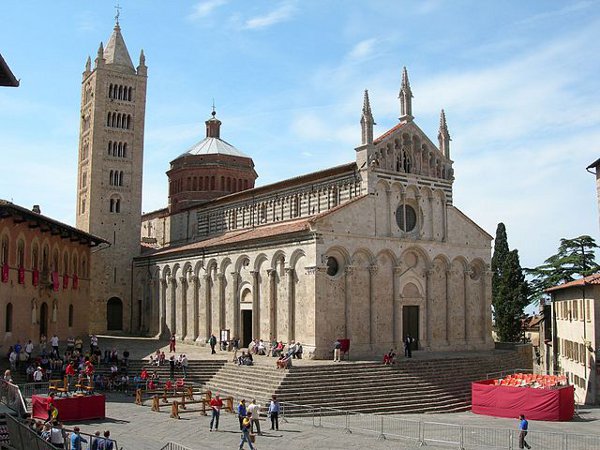
Visiting the city meet the monuments and buildings of extreme particularity, such as the Cathedral of San Cerbone, which was built in 1200 in Romanesque style, today houses a number of important works of art, like a stained glass window made in 1300 representing the Redeemer in Glory and Stories San Cerbone, also a fresco dating back to the fourteenth century and depicting the Madonna and Child Enthroned, frescoes which have as their subject the Crucifixion, the Madonna in Glory with Saints Joseph and Bernard with two monks, attributed to Nasini, San Cerbone with Geese; inside the Cathedral are also a baptismal font, some columns topped by figures of a Griffon, a man with a beard and a horse, a wooden Crucifix by Giovanni Pisano and finally as many as 11 small statues depicting saints and prophets, who along with some frescoes are found in the crypt.

On the square in front of the cathedral are also the Praetorian Palace, built in the thirteenth century, the Palace of the Counts Biserno and the Medieval Palace of the City, one of the main peculiarities of the Tuscan city is to be divided into two parts: the oldest part, surrounded by walls is the Old Town, within which we find the House of San Bernardino and the Palazzina della Zecca, old building where the coins were minted, while, outside the walls meet the Church of San Francesco, in style Gothic, the Church of St. Augustine, the Church of San Rocco, built around 1400, and finally the Renaissance Palace of Arms, which are instead the New Town.

Many museums have been set up in Massa Marittima: the Archaeological Museum, the Mining Museum, the Museum of Art and History of the Mine, the Archaeological Park of Lake dell'Accesa, the Old Mill and Old Joinery.

The origins of the city are to be placed in the Middle Ages, it was built in the territory of Mount Royal and around Mille assumed considerable importance and became a bishopric; Massa Marittima later became the Free City, but it was still conquered and controlled by Pisa, Siena and Florence, under the dominion of which became part of the possessions of the Grand Duchy of Tuscany.

Another element of pride for the city is definitely the award of the Medal of Military Valour, for the courage and the activity of the population in the years of the Second World War.

The city is also famous for its wine DOC, the Monteregio of Massa Marittima, consisting for the most part on the type of Sangiovese and Trebbiano Toscano red for white; famous desserts are also being produced in Massa Marittima, as Panforte, the Seahorses and Ricciarelli.


Quick guide for the search of its solutions for holidays in Cecina.

Those who approach the idea of ​​spending his holidays in Massa Marittima will need to consult a guide to find hotels in Massa Marittima Massa Marittima Hotels or hotels Cecina.


For those in search of the substance and a room can be enough rooms or rooms holiday accommodation Tuscany Coast Tuscany or even rooms for rent Tuscany should be appropriate search terms as well as rooms Massa Marittima.


The Italianists prefer to look for hotels or hotels on the Tuscan coast in Tuscany.


Should nonetheless be acknowledged that Massa Marittima is located on the Etruscan Coast, which is in fact in Tuscany sea, and the Coast Tuscany is unique in the world.


Given that in recent years tourism has largely shown a preference for solutions besides housing type hotel, residences Massa Marittima Massa Marittima holiday apartments, holiday apartments in the Tuscan coastline, have become frequent rumors of research on texts on the Tuscan coast tourism guide .


It is also for this second chapter as previously said about the Etruscan Coast, then in reading pamphlets on Massa Marittima or even where to sleep only to be sought in Tuscany or type the entries residence Massa Marittima Massa Marittima apartments, hotels or even Cecina hotels Massa Marittima.


Then refer to the Help in the Tuscan coast hotels will be well oriented to the voice holidays Tuscan coast and search for hotels in the fen or, if you prefer, hotels Tuscany Coast.


The search for residence on the Tuscan Coast could be profitable since the topic is more general summer holiday in Tuscany, apartments for rent, seaside tuscany, holidays on the sea.


It is not to be neglected even the search for rooms Massa Marittima, in the end we are talking about Tuscany Italy, holiday apartment Tuscany, someone with more economic means seeking Villa Massa Marittima or even Tuscan coast villa rentals Massa Marittima.


For those who opted for a specific area such as the Etruscan Coast Cecina or in a particular way, it will be well to remember that the search terms to be extended in Massa Marittima studios besides vacation rental Tuscany Tuscany or even sea or cottages Massa Marittima.


Finally, not least, we must remember 's Farm or Tuscany Farmhouses Tuscany.


So let's look at farm Massa Marittima.


Then there is the chapter of the holiday apartment very popular among couples and even by couples with a baby. Studios for rent Tuscany is therefore a search term very profitable, as well as studio apartments or houses Tuscany Massa Marittima.

https://tuscanysea.com/backoffice/immagini/tuscanysea.com/25-17-5-2013-11-30-321.jpg

by Valentina
Lucca

Lucca is definitely one of the jewels of Tuscany, mindful of the great moments of splendor, arts, crafts, economy and culture. E '"the encircling the city" as he celebrated the unforgettable Gabriele D'Annunzio. The first traces of man found in the area lead back to the Ligurian people but with the Etruscans, like the rest of Tuscany and the Maremma low, you see a population increase combined with the economic and artistic growth, through trade and trade. The Etruscans and the Romans after they left valuable evidence, the remains of which are present all over the territory.

With the Romans in 89 BC, became the town hall and was perhaps the most intense period of turmoil that lasted about two centuries.

After the Romans it was the turn of the invaders took turns on the conquest of the Italian territory, and obviously suffered the same fate in Lucca, road junction of major roads. First came the Goths, then the Byzantines, the Lombards and later became a duchy and with whom strategic shift, and partly forced, down toward the valley of the Tiber to move to the other Lombard kingdom, Puglia.

Lucca became important in Tuscany thanks to the leader Castruccio Castracani to Paul Guinigi who started the artistic and cultural development. But the reputation of Lucca went beyond the Italian borders spreading its fame thanks to the intense and rich silk trade with l 'Europe and Asia.

In 1799, the city was conquered by the French and by Napoleon, became a principality of Happy Baiocchi and Elisa Bonaparte, sister of the Emperor, until 1814. After the fall nopoleonica, the Austrians held the state until the Congress of Vienna that gave the Duchy of Lucca, in Maria Luisa of Bourbon and his son Charles Louis.

In 1847, Carlo Ludovico gave the Duchy of Tuscany Leopoldo 11, but already in the air were those liberal ideas that would lead a few years later, to join him to Italy.


The University of minters is very old and was already present allíepoca of Lombard rule. Many documents kept in the archives of the Archbishop, documenting their activities. The "Moneturius" (minter) formed a corporation and under the protection of St. Eligio was called Collegium Monetariorum "which was headed by a" Monetae Magister (Master of Coin). All those who belonged to this University were called "Overieri" (those who make money) and admission was not easy because it involved the knowledge of art, as evidenced by their freshman and was made to swear on the Holy Gospels commitment to exercise rectitude the profession granted to Lucca by various emperors. In the premises of the Inquisition of the Mint of Lucca, the "College of minters" is active again with the ancient methods of refining, merge, cut through metal (secrets jealously guarded by a few families of Lucca, called "De lineage Monetae").

Our production is aimed at the reconstruction of the ancient coin reconstruction is done by studying more specimens of the same in weight, size and style so to get a design and a well detailed model, from which they are made punches males, engraved and worked burin. The old Inquisition of the Mint has made in Lucca, at its premises in Via S. Andrea 45 (near the tower Guinigi), an exhibition that traces the history of money over the centuries and can be visited on weekdays and holidays from 9.30 to 13 and 14.30 to 19 dolle except Monday morning.


Visit the villas of Lucca company is of no small importance if you plan to exhaust the discussion of this theme with an excursion for a specified time, you run the risk of usual underwent a 'smattering of news accompanied by a sequence of images that - while picturesque and charming - never going to give us back the full complex of cultural and environmental values ​​of that civilization in the villas of Lucca realizes that - together with the walled city - its highest expressive moment.

More than three hundred large and small are in fact the residences in the Lucchese villa is built over more than four centuries on the most beautiful places in the countryside and the arc of hills surrounding the plain of Lucca, from the early fourteenth century settlements were born as lodges hunting, through the great sixteenth-century villas of the affluent middle-class families engaged in art and in the silk trade, which drew the land and the environment as a superb natural setting, to the numerous imitators that the revival of those models completed the landscape - in later periods and up to the beginning of the twentieth century - with an interminable series of gentle and civilized traits, such as those offered to the visitor even more hasty. This heritage is still all in private hands, which he often passed from one generation to 'other with tender care that the Lucchese manifest in the things that they know are desdnate to stay, and through it is developing a new way to propose to 'external appreciation through the rebirth of hospitality, typical production, hospitality culture and the liberal arts. The visitor is thus faced with a limited repertoire of monuments, but a permanent witness of values ​​that includes architecture, landscape, agriculture, traditional activities, food and wine, and even recesses of quiet and meditation, contemplation and spiritual regeneration, enjoyment of the environment in corrupt, in which it is necessary to penetrate with progressive enthusiasm, without the feverish restlessness of tourist to time, seeking as the measure for each one proves to be more convenient. In other words, on tiptoe.

Says Borchardt, he clearly recognized the Lucca and long stays there: "The villa honors already far away to visitors, ripagandolo of all that denies him until he èsemplice tourist". Anyway, this trip must be organized in one or more paths, none of which - say it now - will be limited to the theme of the villas of Lucca, perhaps because the temptation would be to wander around aimlessly, following a wall of stones picked clean by the wind and surprisingly elegant meeting tables of ancient palaces hidden among the branches of trees, or enchanted by strong scents of the wine bubbling in the cellar and wait for the hills resolve the rosy sunsets. It is a journey that has few stages safe and is often entrusted to the initiative of the ancient character of the stranger, the once neglected mails to stop and investigate signs of civilization, choosing them in the vast panorama as in the apparently insignificant details and what drawing from the rest for the spirit that - at the end of the pilgrimage - gave him the certainty more returning better than when he left.


National Museum of Palazzo Mansi

It was purchased in 1965 by the Italian State as the venue for hosting the paintings of the national museums of Lucca.

National Museum of Palazzo Mansi

Via Galli Tassi, 43 - 0583/55570 - Fax 0583 / 31.22.21 - Opening 9/19 festive * 9/14 * closed on Mondays.


Cathedral Museum

E 'consists of a thirteenth century tower house, a sixteenth-century church and a main body of the fourteenth century. On display are works of art that have characterized the centuries attachment and devotion to the emblematic figure of the Holy Face - ancient crucifix venerated in the Middle Ages throughout Europe.

In the sacristy of the Cathedral is visible what until now was considered that the tomb of Jacopo della Quercia carved llaria the Wheelbarrow - wife of Paul Guinigi who was the lord of Lucca between 1400 and 1430.

Cathedral Museum - Via Archbishopric - 0583 49.05.30 - Open daily April / Oct 10/18 - Nov / Tue 10/14 - Holidays 10/17


Lucca still retains its entire mighty walls, created primarily to strike military and administrative organization, because no one ever tried to capture it. The walls can be covered as a walk under a century-old trees that were planted allíepoca to cover the view of the towers in case of attack, but also as a supply of firewood.

In the following centuries the circle of ramparts was transformed into a sort of hanging garden suspended over the city. For centuries, the people of Lucca there had illegally planted small gardens, I had sent to graze their horses, while the ditches were used as external wheat fields or pastures for their herds.

The walk up the wall preferably on foot or in a carriage divenutaa in the eighteenth century was a must when you received principles strangers and an event not to be missed in the monotonous days of the nobility during the summer.

Even today, the ancient walls of the Lucchese have managed to preserve, protect the city center from the chaos outside, enveloping charm of one of the most beautiful cities díItalia and visitors should not miss líebrezza you feel in a relaxing and scenic stroll traveled for centuries of history.


The Villas of Lucca

The beautiful villas that can be seen in the most evocative of the countryside of Lucca, were built in the course of more than four centuries. There are over three hundred, including some fourteenth-century born as hunting lodges, like other great sixteenth-century villas of middle-class families and wealthy merchants of silk.

This heritage is still all in private hands,

meticulously passed down from one generation to another and strictly as. Only some of these villas can be visited today and can offer a welcome worthy of the best traditions of Lucca.

The structural matrix and formal Lucca is the presence of the villas, including this sense the whole of the villa itself: the whole property consists of real estate from the main building, the park, the farm, the farm houses, from the agrarian , by the woods and waterways. "The villa is harmonic distinction of vineyards and olive groves, cultivated fields and wild areas, houses of peasants and abode of the Lord" (Isa Belli Barsali) is the work of an urban middle class that invested the fruit of their earnings in land. A set built as a work of art, from a people refined. But this landscape, so popular today, it is not only the result of an operation of investment land. In the structural organization of this territory everything was kept in mind: the position of the land, water regulation, the order of the crops, the placement of buildings, the layout of the trees with great simplicity, modesty, functionality, order, poise, rigor. A common matrix for the organization and its definition is given by the accommodation in terraces or knolls of the land. With this technique, transformed the grounds of steep hill in flat parts, preventing soil erosion and harnessing the waters, regimate, you convogliarono where the man wanted to. It is the grand design of the Tuscan hills, is "adorned the amphitheater of hills" Borchardt, a series of signs, parallel to each other, curvilinear, that shape variously, but with continuity, the local context of the villa, constitute the bottom. It 's the result of the struggle, or the dialogue between man and nature to force, or to convince her to productive use, in accordance with its structure. It is the result of a secular work of which there are, in Lucca, certain documents by the end of the thirteenth century. This distinctive landscape Lucca is no exception to that Montaigne in the Journal de Voyage, in 1580, wrote: "On ne peut trop loeur the utilité et la beauté de la méthode de cultiver qu'ils ont les Montagnes jusqu'à the peaks, en faisant y, en forme d'escalier ... ". In the relationship between settlement hills and crops, including villa, garden and landscape materials used also play a fundamental role: they are cooked on-site materials, such as brick kilns of the local (now all abandoned or demolished), limes prepared with limestone ceroid of Santa Maria del Giudice, sands and pebbles of the Serchio, the stones. It is precisely the stone materials to act as constitutive elements such as rags construction or as a cutting material, are used in the enclosure walls, the gates in the architecture, in pavements, in creases in the decorative bands, in the frames of doors and windows, in houses and oratories. The quarries of Matraia and Guamo were those that were addressed, one to the north, the other south almost to serve impartially two shares significant settlement of the villas. Yet the stones were also used together in dialogue with the brick, with their diversity of color. Sites rich in springs or served by a stream, with straightforward as possible derivations, were the ones most sought for the construction of the villas. The water in the villa, not only performs tasks related to the purely functional home life and agricultural work, became the occasion for the creation of works of embellishment and fun, of pure pleasure. The architecture of the water together with the architecture of the green form the micro-landscape inside the closed area of ​​the villa; reach the highest levels of quality and hydraulic technique found in the many water lilies, ponds and fish ponds, with games secrets of water, varied architectural solutions, enhanced by statues and decorations made of rustic mosaics, stones of various colors, shells, with grotesque and monstrous. What nymphaeums are important and also studied the play of light that penetrate inside of these architectures in which the light beams form rainbows with the dust of water. But the game, the pleasure reunite properly, in a sort of civic sense and respect, which is typical of the soul of Lucca, to his neighbor: the water is not dispersed, is not altered, can shut down the available to the other.

https://tuscanysea.com/backoffice/immagini/tuscanysea.com/-17-5-2013-11-28-281.jpg https://tuscanysea.com/backoffice/immagini/tuscanysea.com/-17-5-2013-11-28-282.jpg

by Valentina
Livorno

From the origins to the Medici.

The first historical evidence relating to Licorno dates from the ninth century, when the settlement was nothing more than a fraction of the Port Pisano.Il Its development began in the late thirteenth century, when, with the statutes of Pisa in 1284, it was determined that the captain the port had to live in Livorno.Gli same statutes, in order to populate the harbor village, They arranged for special customs facilities and privileges to all those who, within the next ten years, they decided to establish his residence and activities Livorno.Ma August 1284 Pisa and Livorno were attacked by the Genoese and Lucca, which arrecarono a lot of damage to the towers and castle Livorno.Siglata peace in 1299, began the reconstruction period, which culminated with the fortification of the port of Livorno. Inextricably bound to Pisa, Livorno suffered the same sorti.In following the killing of Peter Gambacorta in 1392, lord of Pisa from 1370, the city and its port passed for several years under the rule of the Duke of Milan Gian Galeazzo Visconti. Pisa was able to rebel against the dominion of the Visconti in 1405, but the following year it had to surrender to a new enemy: Firenze.Livorno in the meantime had passed under the government of Genoa, which lasted until 1421, when the Genoese decided to consent to repeated request of Florence to buy Livorno.Il Doge Tommaso Fregoso, being in need of money to defend the Republic of Genoa from the Milanese, revenges Livorno to Florence in June 1421 for 100,000 gold florins. To purchase the Florentine Republic Livorno meant to have a port of its own for those international trade for which Florence had long famosa.Esattamente as he had done in 1284, Pisa, Florence also decided to facilitate the population of Livorno.Molti Florentine artisans settled there to build galleys desired by the republic for the transport of goods.

1200 florins a year were allocated for the construction of a jail every six mesi.La Republic also decided to keep in Livorno a series of tax breaks to allow the development of the port city which later silting of the port of Pisa soon became the first port of call is the Toscana.Ma with the ascent to power of the Medici that the history of Livorno lived a real svolta.Già the beginning of the sixteenth century, Cardinal Giulio de 'Medici, then ascended to the papal throne in 1523 with the the name of Pope Clement VII, commanded by Antonio da Sangallo the Elder design for a fortress difensiva.Non are certain the dates of construction of what is now called the Old Fort, according to some historical fact, the defensive building was erected between 1521 and 1524, while according to others the work continued until after the 1530.E 'instead sure Sangallo fortress incorporated into some existing structures like the tower of Matilde and the "quadrature of Pisa."


Livorno under the Grand Duchy of Tuscany.

The first Grand Duke of Tuscany, Cosimo I, in 1548 issued a law with which was granted to any person who decides to settle in Livorno, the cancellation of any debt incurred in precedenza.La law meant that by the mid-sixteenth century Livorno began to learn about the phenomenon of immigration destined to become more and more consistent with the laws of the 1593.Cosimo I also ordered Giorgio Vasari, a project for the construction of the new pier, and in the meantime he thought to further fortify the city continued to grow in importance . Once dead Cosimo I, his son Francis, he continued the work, addressing the architect Bernardo Buontalenti for the design of a new Livorno, a sort of fortress city with the Cathedral at its March 28, 1577 centro.Il the same Francis I , during a solemn ceremony, laid the foundation stone of the new walls of the Medici Grand Duke Livorno.Il that more than others, however, tied its name from the city of Livorno was Ferdinand I, brother of Francis I and came to power in 1587. It was in fact ordered to Realize the project Buontalenti. Livorno therefore became a city with strong walls surrounded by a waterway, full of palaces, warehouses, barracks and other dogane.Un waterway joined Livorno Pisa.Ma what most of all contributed to the rapid development of the port city was the publication. June 10 of 1593, the famous "read Livornine" in favor of the merchants of every place and every religione.In practice it was a real indulgence with which he favored the

Population of the city, giving political asylum to all those who wished to settle in Livorno and open up a business. Law favored especially the Jews, who landed in the Tuscan port a bit 'from all countries Europei.Nel 1606, three years before death, Ferdinand I wished to crown his work by raising the honor of Livorno city.The son of Ferdinand, Cosimo II, found itself to administer a city flourishing, full of artisans and merchants, where they crossed races and cultures very different between loro.Livorno, in the seventeenth century, was a rare example of coexistence among many peoples and at the end of 1700 had already become the second largest city in Tuscany with 80,000 inhabitants (Florence had 100,000). Under Cosimo II was made the Medici Port, and the city was declared a free port.


Livorno today.

With Cosimo II closes the period of maximum development of Livorno, which however continued to thrive seeing their commerci.Nessuno of the Grand Dukes later took it to the city customs privileges that had allowed the rapid evolution. With the annexation of the Grand Duchy of Tuscany to the Kingdom of Italy, Livorno underwent a new development, no longer linked only to the commercial port, but also to some industrial activities connected to it.

To shipyards slowly joined by other industrial activities (chemical, petrochemical, engineering, conservation of fish) that have now made Livorno a modern and very attivo.Anche tourist activity emerged in the late nineteenth century, transforming a station in Livorno much sought after and renowned seaside resort at the start of our secolo.La city experienced an important cultural season, inspired by writers such as

Marranos, and painters like Modigliani Factors and musicians such as Pietro Mascagni, all of birth Livorno.

The Second World War caused much damage to Livorno, who also knew how to recover through rapidità.Oggi the city has more than 170,000 inhabitants, and the province, which stretches all along the coastline, includes 20 Comuni.Ben five of the seven islands that make up the 'archipelago toscan0 are also in the province of Livorno: Gorgona, Capraia, Elba, Montecristo and Pianosa.


ART

Churches and palaces

The center of the ancient city designed by Buontalenti represented by Piazza Grande, which overlooks the cathedral dedicated to Saint Francis, and built between 1594 and 1606 and designed by Alessandro Pieroni.Il cathedral was later expanded during the bombing 1700.I World War II earned him considerable damage to the Cathedral of Livorno, which was then rebuilt along the lines originali.L 'interior has a Latin cross with a single nave, and there are precious works, such as the Assumption of Passignano and St. Francis receiving Child of Mary Empoli. To the right of the entrance you can admire the monument to the Marquis Marco Alessandro del Borro, the work of the Florentine artist Giovan Battista Foggini.Piazza Grande was completely rebuilt after the Second World War, and therefore the buildings surrounding it are all impression moderna.Dietro to the Grand Palace, which is located in front of the Duomo, opens wide the Town Hall with the Town Hall built in 1720 and designed by John Fantasia.All the 'interior of the building it has a fine painting of Sustermans, which portrays the Grand Duke Ferdinand II in the act of receiving the mercanti.Imboccando Via S. John arrives at the church of the same name originally from the thirteenth century and enlarged in 1624.Non far from the church of St. John the Baptist is the temple dedicated to Santa Caterina, which is also an eighteenth century work of John of fantasy within the coronation of the Virgin of Giorgio Vasari.Ancora to oggini must instead the design of the church of San Ferdinando, also called the spreader, built between 1707 and 1714.Senza doubt it is one of the most interesting churches in the city with beautiful works of Giovanni Baratta all ' interno.All 'corner between the Piazza Grande and Guerazzi is the palace of the call a beautiful building built in 1707 for use militari.Non far it meets the Costernino, ie the building where it was regulated water distribution. The Costernino is the work of neoclassical structure designed by Pasquale Poccianti in 1842.Pochi years before, between 1829 and 1832, the same Poccianti had achieved Cisternone, ie the reservoir of the aqueduct. Near the Cisternone is the Palazzo De Larderei school, built in neoclassical style in the well 18321850, industrialist De Larderei.

Just south of Livorno is the Shrine of Our Lady of Montenero, built in the sixteenth century on a hill instead of a pre-existing oratorio.Secondo to legend, in 1345, an image of the Virgin Mary came from the island Ardenza Eubea.L ' image was brought by some hermits on the hill and enclosed within a oratorio.Ben soon the fame of the miracles of Our Lady of Montenero spread along the Tyrrhenian coast, and the shrine became a place of pellegrinaggi.Alle walls of the sacristy are many votive testifying the cult that has grown over the centuries around the Madonna di Montenero.


The city Medici

The heart of the ancient city is the Cathedral, built by Bernardo Buontalenti at the center of the pentagon wall that surrounded the Livorno Rinascimento.Il the Royal Canal marks the ancient town in the south, while to the north-west and north-east are respectively the Old Fortress and the Fortress Nuova.Voluta by Duke Alessandro de 'Medici the Old Fortress was designed by Antonio da Sangallo.I works for the construction of the fortress began in 1531 and lasted until 1537.La fort has a perimeter wall of 500 three meters bastioni.Su one of the two portals of entry is the coat of arms of the Duke instead Alessandro.La New Fortress was built in 1590, under the Grand Duke Ferdinando I, the design of Giovanni de 'Medici, Vincenzo Bernardo Bonanni and Buontalenti.In Originally, the two forts were linked by a curtain that was torn down during the seventeenth century to make room for new neighborhoods of Venice and San Marco, the most characteristic città.Immediatamente south of the Old Fortress opens the Medici Port, with the old dock, Fortino's Sassaia and Molo Mediceo.Da latter reach the Tower of the light, erected the first time in the sixteenth century and destroyed during the War mondiale.La tower was rebuilt in 1955 according to the guidelines originarie.Alla its base are the remains of the hospital built by Francis I in 1582.

On the eastern side of the Old Dock-open piazza Giuseppe Micheli.E 'here that was erected in 1607 what later became the sculpture symbol of Livorno: the Monument to Ferdinand I, also known as the Four Mori.Si is a statue the Grand Duke in the uniform of the Knights of Santo Stefano sculpted by Giovanni Bandini and placed on a plinth around which there are four Moors in chains, to be cast by Pietro Tacca and added to the monument at a later tempo.I four Turkish slaves were merged with cannons taken from the Arabs and the Turks won by the soldiers of the Grand Duchy during the daring expedition in 1607 by Ferdinand I really wanted to conquer the city of Hippo.


I Macchiaioli and museum Giovanni Fattori.

Around the middle of last century, Florence was formed the most important and constructive work of the Italian artistic movement, that of Macchiaioli.La school macchiaioli was born in opposition and contrast academicism that had characterized the first half of the century with its "Historical paintings." The theory was the basis of this artistic movement was that of the "spot", which chronologically precedes the French impressionism and that in some respects there avvicina.I macchiaioli believed that the painter had to make exactly what the human eye perceives, ie colored patches of light and ombra.Il more representative of the movement of macchiaioli was the painter Giovanni Fattori, born in Livorno in 1825.E right in the most important exponent of the "stain" Livorno titled a museo.Il Civic Museum Giovanni Fattori located in the park of Villa Fabbricotti, in a building ottocentesca.Il museum houses a collection of paintings of factors including "Haystack, Oxen, Antignano, On the Beach, Red Tower, Lutteri Battle of San Martino, Mrs. Martelli, Portrait of the Wife. " The Museum possesses some ancient works such as the Madonna and Child attributed to Sandro Botticelli and the Crucifixion of Blacks by Bicci.


Museo Civico Giovanni Fattori


Villa Mimbelli

Via San Jacopo in Acquaviva

Phone 0586.808001 - 804847

The important collection of paintings by Giovanni Fattori and other Macchiaioli and post macchiaioli stored at Livorno - that was the birthplace of factors - has received a rational arrangement and a worthy place in the prestigious Villa Mimbelli.

In the beautiful rooms of the Villa, built in 1865 by architect Giuseppe Micheli and recently restored, the civic collection 'was rearranged according to a precise criteriostorico artistic and enriched by a new group of interesting works hitherto preserved in deposits.

Overall we were able to have on the three floors of the works so far villacecentotrentasei depositi.Oltre preserved in the paintings of factors, which are the most 'valuable riccae of the collection, the new Museum offers the public the chance and aglistudiosi' to appreciate famous and important operedi painters, such as, Silvestro Lega, Caesar and John Bartolena, the Tommasi, Vittorio Corcos, Michele Gordigiani, Leonetto Cappiello and others, that have characterized the artistic events italianea horse between eight hundred and nine hundred

https://tuscanysea.com/backoffice/immagini/tuscanysea.com/23-17-5-2013-11-18-561.jpg https://tuscanysea.com/backoffice/immagini/tuscanysea.com/23-17-5-2013-11-18-562.jpg

by Valentina
Follonica

Follonica is a beautiful seaside town in the province of Grosseto, overlooking the magnificent sea of Tuscany.

Famous for good hospitality and its sandy beach, combining the good liveliness of the town with the pure sea, named Blue Flag for several consecutive years.


The reception is based on a number of Hotels, Residences, Apartments and Bed and Breakfast.

Particularly popular with families for the tranquility of the place and the sea is always calm and goes down very slowly.


source : www.follonica.com

by Valentina