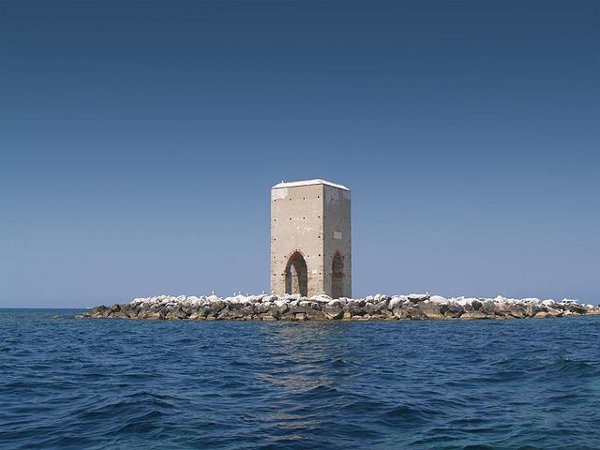
An islet, or more exactly a rocky outcrop surrounded by cliffs above the water in the Upper Tyrrhenian Sea, nine kilometers long and two wide, in front of Livorno which is just a short distance to the sea: this is the Meloria, famous for the battle of August 6, 1284 which marked the great defeat of the Pisan fleet perpetrated by the Genoese. But the Meloria is also a place, from antiquity to the present, for the extraordinary landscape and nature, for morphological details that distinguish it. In this book, a famous explorer of the exotic seas of the Mediterranean and in particular, how Folco Quilici, a historic student of Marco Tangheroni as Olimpia Vaccari, a naturalist and Livorno, such as Gianfranco Barsotti, who Meloria and nature below the its sea knows all, we return to this place that belongs to the collective of the civilizations of the Mediterranean’s most important aspects. The book also in the photographs of Fabio Jackdaw, for the emerged part, and William Cicerchia and Federico Fiorillo, for the submerged part, amazing images and highly suggestive.
Cursed meloria
Renzo Castelli
The defeat still burns with Genoa, seven centuries later. Maybe it’s time to get over it … I’m not rooting athlete nor traditions are often a little ‘fake driven by tourism, to draw the very soul of a city. In the case of Pisa, his “pisanità.” In a few cities, like this one, the story, and then the remote past, have left their mark so marked and conditioning. Pisa has too much memory – the Etruscan origin, the size of its navy – to forget. That’s why even today the Meloria is not only the name of a battle ended in defeat, one of many that man has fought on land and sea, but it is the death of a city-state, the humiliation of its citizens. With the Meloria (1284) Pisa has lost her pride, dreams, royalty, and never will forget the lost power. The city-state he bowed his head, perhaps forever, and never forget again. Pisa, which had been (Rudolf Borchardt) “an empire of sails”, it remains for ever and ever defeat a city, humiliated, disappointed. Pisa, or wounded pride. It was not just Meloria to dig the large groove that casts its shadow down to us. For the 12,000 dead of the battle that wiped out the soul of the great city-states, were joined by 6 thousand prisoners brought in chains in the prison Genoese module that caused a demographic crisis that seemed irreparable. “This situation – says the historian Emilio Tolaini – led to a sharp increase immigrativo from the country that made it possible to reconstruct in some way the network traffic.” But the return to a seminormalità was not true glory: just a century later, in fact, the Florentines buy Pisa and its port.
If it is true that every city has its own soul which is the result of the souls of those who have always lived, many agree that Pisa still a sullenness is the daughter of the most stinging defeat. Grumpy therefore, proud that he judged Borchardt in the last century, and the judgment still stands. For these reasons, nell’effervescente and inventive Tuscany, in the blasphemous, Pisa is placed with different characters from every other tower. The “pisanità”, even today, it means mistrust because distrust is the daughter of wounded pride. Not by chance Curzio Malaparte, in designing its Cursed Tuscans, glissò entirely of Pisa. He confessed: “I do not understand them, they Pisa. They have a character evasive, disingenuous. It almost seems like something that should be forgiven. But what? “. The answer would be the same today: to be forgiven to have lost. Yet Malaparte loved Pisa, nightclubs as well as its silences the voices of the students, the extraordinary beauty of the marble and the Arno river that flowed to the sea. Although preferred that river and the ice storms of winter because the “peat” meant the entrance into the EEC Arno. And for a plate of EEC consumed in Piazza Garibaldi, at the inn of the Nile Montanari, Malaparte would have given up the ghost. (Do not know what are the EEC? We can not explain it: come to Pisa and you’ll understand). And with the innkeeper friend, Malaparte confided: “You are a strange breed, but cooked well.”
Dante saw to his own time and with some effectiveness to denounce the horrible guilt of Pisa. After Meloria, Count Ugolino della Gherardesca held liable for incompetence or betrayal of that defeat, he was locked up to starve to death, with his sons and grandsons in the historic tower in Piazza delle Sette Vie (today, the Knights of St. Stefano). The Dante’s invective is strong, but if the poet had known the result would have written things even worse. The bones of Count Ugolino, in fact, were later buried in the face to the river along the river Tramontana and that land remained forever cursed. Who Tread today visit Pisa and its riversides, will find that long line of buildings is interrupted, just before the church of the Holy Sepulchre, by a garden, the only one that can appear on the embankment. But it is not a garden, and there is a cemetery: it is cursed land. Why not forget the people of Pisa. Even today the bones of the count found peace – hopefully – in the convent of St. Francis, on that land will never be allowed to build anything.
No, Pisa can not be considered a city “normal”, as well understood Malaparte. Says Professor Silvano Burgalassi, a sociologist and expert on most of the soul of Pisa “Pisa lives of the past and unable to express the values of art, spirituality, intelligence of which also bears. It is a kind of brake, almost a curse, which does not know how to free. Today we could no longer do the Piazza del Duomo or riversides because it would lack the ability of inspiration that were the Pisans before Meloria, when they ruled the seas and saw their mission in this divine something that should be celebrated with dignity. Since then, the soul of Pisa is suffering from wounded pride and is not capable of expressing a depth of thought that is in tune with their times. “
Yet Pisa today would have much to brag about. It has all the requirements to be a happy city: a mild climate, the sea six miles, the hill to seven, the mountain for skiing less than an hour, it has a central position, an international airport, a port (the “port of Pisa”, which some call Livorno) at 20 kilometers, has three prestigious universities and one of the largest national nuclei of the CNR, he finally museums and monuments around the world envies us. But it is not a happy city.
How much will have to go because Pisa recover its serenity, forget his defeat and his empire lost, because the “pisanità” finally becomes a positive feeling? No one can say. But it will not be the folklore to heal the wounded pride. The Pisan contemporaries in shadow that simulates a false folklore, once a year, the glory of a maritime republic that no longer exists. Indeed, consider that race a little ‘blasphemous, a comparison of muscular athletes who do not have the right to evoke the splendor of an era.
Yet the “pisanità” sick, this grumpy mood, this malaise of the present, often escapes to visitors. If Malaparte was wary of Pisa and Pisa, other visitors instead found a great serenity in the silence of the city, in its pathos.
Elizabeth Barrett wrote: “Pisa, here is a small, charming town of silence. Sleepy streets where grass grows between the stones, where groups of boys frolic in solitude. ” Seen by others, Pisa can really look like, tender and silent rather than haughty and sullen. And then, tormented souls, Pisa can be ideal: if his wounded pride is not apparent, it remains untouched by the fragrant golden oasis that reigns in the streets and squares, so that Shelley could find the inspiration for the comporvi ‘ In elegy death of Keats and Leopardi write in an April night, the scent of wisteria, poetry A Silvia.