Search

Category Archives: Explore Tuscany

Livorno

From the origins to the Medici.

The first historical evidence relating to Licorno dates from the ninth century, when the settlement was nothing more than a fraction of the Port Pisano.Il Its development began in the late thirteenth century, when, with the statutes of Pisa in 1284, it was determined that the captain the port had to live in Livorno.Gli same statutes, in order to populate the harbor village, They arranged for special customs facilities and privileges to all those who, within the next ten years, they decided to establish his residence and activities Livorno.Ma August 1284 Pisa and Livorno were attacked by the Genoese and Lucca, which arrecarono a lot of damage to the towers and castle Livorno.Siglata peace in 1299, began the reconstruction period, which culminated with the fortification of the port of Livorno. Inextricably bound to Pisa, Livorno suffered the same sorti.In following the killing of Peter Gambacorta in 1392, lord of Pisa from 1370, the city and its port passed for several years under the rule of the Duke of Milan Gian Galeazzo Visconti. Pisa was able to rebel against the dominion of the Visconti in 1405, but the following year it had to surrender to a new enemy: Firenze.Livorno in the meantime had passed under the government of Genoa, which lasted until 1421, when the Genoese decided to consent to repeated request of Florence to buy Livorno.Il Doge Tommaso Fregoso, being in need of money to defend the Republic of Genoa from the Milanese, revenges Livorno to Florence in June 1421 for 100,000 gold florins. To purchase the Florentine Republic Livorno meant to have a port of its own for those international trade for which Florence had long famosa.Esattamente as he had done in 1284, Pisa, Florence also decided to facilitate the population of Livorno.Molti Florentine artisans settled there to build galleys desired by the republic for the transport of goods.

1200 florins a year were allocated for the construction of a jail every six mesi.La Republic also decided to keep in Livorno a series of tax breaks to allow the development of the port city which later silting of the port of Pisa soon became the first port of call is the Toscana.Ma with the ascent to power of the Medici that the history of Livorno lived a real svolta.Già the beginning of the sixteenth century, Cardinal Giulio de 'Medici, then ascended to the papal throne in 1523 with the the name of Pope Clement VII, commanded by Antonio da Sangallo the Elder design for a fortress difensiva.Non are certain the dates of construction of what is now called the Old Fort, according to some historical fact, the defensive building was erected between 1521 and 1524, while according to others the work continued until after the 1530.E 'instead sure Sangallo fortress incorporated into some existing structures like the tower of Matilde and the "quadrature of Pisa."


Livorno under the Grand Duchy of Tuscany.

The first Grand Duke of Tuscany, Cosimo I, in 1548 issued a law with which was granted to any person who decides to settle in Livorno, the cancellation of any debt incurred in precedenza.La law meant that by the mid-sixteenth century Livorno began to learn about the phenomenon of immigration destined to become more and more consistent with the laws of the 1593.Cosimo I also ordered Giorgio Vasari, a project for the construction of the new pier, and in the meantime he thought to further fortify the city continued to grow in importance . Once dead Cosimo I, his son Francis, he continued the work, addressing the architect Bernardo Buontalenti for the design of a new Livorno, a sort of fortress city with the Cathedral at its March 28, 1577 centro.Il the same Francis I , during a solemn ceremony, laid the foundation stone of the new walls of the Medici Grand Duke Livorno.Il that more than others, however, tied its name from the city of Livorno was Ferdinand I, brother of Francis I and came to power in 1587. It was in fact ordered to Realize the project Buontalenti. Livorno therefore became a city with strong walls surrounded by a waterway, full of palaces, warehouses, barracks and other dogane.Un waterway joined Livorno Pisa.Ma what most of all contributed to the rapid development of the port city was the publication. June 10 of 1593, the famous "read Livornine" in favor of the merchants of every place and every religione.In practice it was a real indulgence with which he favored the

Population of the city, giving political asylum to all those who wished to settle in Livorno and open up a business. Law favored especially the Jews, who landed in the Tuscan port a bit 'from all countries Europei.Nel 1606, three years before death, Ferdinand I wished to crown his work by raising the honor of Livorno city.The son of Ferdinand, Cosimo II, found itself to administer a city flourishing, full of artisans and merchants, where they crossed races and cultures very different between loro.Livorno, in the seventeenth century, was a rare example of coexistence among many peoples and at the end of 1700 had already become the second largest city in Tuscany with 80,000 inhabitants (Florence had 100,000). Under Cosimo II was made the Medici Port, and the city was declared a free port.


Livorno today.

With Cosimo II closes the period of maximum development of Livorno, which however continued to thrive seeing their commerci.Nessuno of the Grand Dukes later took it to the city customs privileges that had allowed the rapid evolution. With the annexation of the Grand Duchy of Tuscany to the Kingdom of Italy, Livorno underwent a new development, no longer linked only to the commercial port, but also to some industrial activities connected to it.

To shipyards slowly joined by other industrial activities (chemical, petrochemical, engineering, conservation of fish) that have now made Livorno a modern and very attivo.Anche tourist activity emerged in the late nineteenth century, transforming a station in Livorno much sought after and renowned seaside resort at the start of our secolo.La city experienced an important cultural season, inspired by writers such as

Marranos, and painters like Modigliani Factors and musicians such as Pietro Mascagni, all of birth Livorno.

The Second World War caused much damage to Livorno, who also knew how to recover through rapidità.Oggi the city has more than 170,000 inhabitants, and the province, which stretches all along the coastline, includes 20 Comuni.Ben five of the seven islands that make up the 'archipelago toscan0 are also in the province of Livorno: Gorgona, Capraia, Elba, Montecristo and Pianosa.


ART

Churches and palaces

The center of the ancient city designed by Buontalenti represented by Piazza Grande, which overlooks the cathedral dedicated to Saint Francis, and built between 1594 and 1606 and designed by Alessandro Pieroni.Il cathedral was later expanded during the bombing 1700.I World War II earned him considerable damage to the Cathedral of Livorno, which was then rebuilt along the lines originali.L 'interior has a Latin cross with a single nave, and there are precious works, such as the Assumption of Passignano and St. Francis receiving Child of Mary Empoli. To the right of the entrance you can admire the monument to the Marquis Marco Alessandro del Borro, the work of the Florentine artist Giovan Battista Foggini.Piazza Grande was completely rebuilt after the Second World War, and therefore the buildings surrounding it are all impression moderna.Dietro to the Grand Palace, which is located in front of the Duomo, opens wide the Town Hall with the Town Hall built in 1720 and designed by John Fantasia.All the 'interior of the building it has a fine painting of Sustermans, which portrays the Grand Duke Ferdinand II in the act of receiving the mercanti.Imboccando Via S. John arrives at the church of the same name originally from the thirteenth century and enlarged in 1624.Non far from the church of St. John the Baptist is the temple dedicated to Santa Caterina, which is also an eighteenth century work of John of fantasy within the coronation of the Virgin of Giorgio Vasari.Ancora to oggini must instead the design of the church of San Ferdinando, also called the spreader, built between 1707 and 1714.Senza doubt it is one of the most interesting churches in the city with beautiful works of Giovanni Baratta all ' interno.All 'corner between the Piazza Grande and Guerazzi is the palace of the call a beautiful building built in 1707 for use militari.Non far it meets the Costernino, ie the building where it was regulated water distribution. The Costernino is the work of neoclassical structure designed by Pasquale Poccianti in 1842.Pochi years before, between 1829 and 1832, the same Poccianti had achieved Cisternone, ie the reservoir of the aqueduct. Near the Cisternone is the Palazzo De Larderei school, built in neoclassical style in the well 18321850, industrialist De Larderei.

Just south of Livorno is the Shrine of Our Lady of Montenero, built in the sixteenth century on a hill instead of a pre-existing oratorio.Secondo to legend, in 1345, an image of the Virgin Mary came from the island Ardenza Eubea.L ' image was brought by some hermits on the hill and enclosed within a oratorio.Ben soon the fame of the miracles of Our Lady of Montenero spread along the Tyrrhenian coast, and the shrine became a place of pellegrinaggi.Alle walls of the sacristy are many votive testifying the cult that has grown over the centuries around the Madonna di Montenero.


The city Medici

The heart of the ancient city is the Cathedral, built by Bernardo Buontalenti at the center of the pentagon wall that surrounded the Livorno Rinascimento.Il the Royal Canal marks the ancient town in the south, while to the north-west and north-east are respectively the Old Fortress and the Fortress Nuova.Voluta by Duke Alessandro de 'Medici the Old Fortress was designed by Antonio da Sangallo.I works for the construction of the fortress began in 1531 and lasted until 1537.La fort has a perimeter wall of 500 three meters bastioni.Su one of the two portals of entry is the coat of arms of the Duke instead Alessandro.La New Fortress was built in 1590, under the Grand Duke Ferdinando I, the design of Giovanni de 'Medici, Vincenzo Bernardo Bonanni and Buontalenti.In Originally, the two forts were linked by a curtain that was torn down during the seventeenth century to make room for new neighborhoods of Venice and San Marco, the most characteristic città.Immediatamente south of the Old Fortress opens the Medici Port, with the old dock, Fortino's Sassaia and Molo Mediceo.Da latter reach the Tower of the light, erected the first time in the sixteenth century and destroyed during the War mondiale.La tower was rebuilt in 1955 according to the guidelines originarie.Alla its base are the remains of the hospital built by Francis I in 1582.

On the eastern side of the Old Dock-open piazza Giuseppe Micheli.E 'here that was erected in 1607 what later became the sculpture symbol of Livorno: the Monument to Ferdinand I, also known as the Four Mori.Si is a statue the Grand Duke in the uniform of the Knights of Santo Stefano sculpted by Giovanni Bandini and placed on a plinth around which there are four Moors in chains, to be cast by Pietro Tacca and added to the monument at a later tempo.I four Turkish slaves were merged with cannons taken from the Arabs and the Turks won by the soldiers of the Grand Duchy during the daring expedition in 1607 by Ferdinand I really wanted to conquer the city of Hippo.


I Macchiaioli and museum Giovanni Fattori.

Around the middle of last century, Florence was formed the most important and constructive work of the Italian artistic movement, that of Macchiaioli.La school macchiaioli was born in opposition and contrast academicism that had characterized the first half of the century with its "Historical paintings." The theory was the basis of this artistic movement was that of the "spot", which chronologically precedes the French impressionism and that in some respects there avvicina.I macchiaioli believed that the painter had to make exactly what the human eye perceives, ie colored patches of light and ombra.Il more representative of the movement of macchiaioli was the painter Giovanni Fattori, born in Livorno in 1825.E right in the most important exponent of the "stain" Livorno titled a museo.Il Civic Museum Giovanni Fattori located in the park of Villa Fabbricotti, in a building ottocentesca.Il museum houses a collection of paintings of factors including "Haystack, Oxen, Antignano, On the Beach, Red Tower, Lutteri Battle of San Martino, Mrs. Martelli, Portrait of the Wife. " The Museum possesses some ancient works such as the Madonna and Child attributed to Sandro Botticelli and the Crucifixion of Blacks by Bicci.


Museo Civico Giovanni Fattori


Villa Mimbelli

Via San Jacopo in Acquaviva

Phone 0586.808001 - 804847

The important collection of paintings by Giovanni Fattori and other Macchiaioli and post macchiaioli stored at Livorno - that was the birthplace of factors - has received a rational arrangement and a worthy place in the prestigious Villa Mimbelli.

In the beautiful rooms of the Villa, built in 1865 by architect Giuseppe Micheli and recently restored, the civic collection 'was rearranged according to a precise criteriostorico artistic and enriched by a new group of interesting works hitherto preserved in deposits.

Overall we were able to have on the three floors of the works so far villacecentotrentasei depositi.Oltre preserved in the paintings of factors, which are the most 'valuable riccae of the collection, the new Museum offers the public the chance and aglistudiosi' to appreciate famous and important operedi painters, such as, Silvestro Lega, Caesar and John Bartolena, the Tommasi, Vittorio Corcos, Michele Gordigiani, Leonetto Cappiello and others, that have characterized the artistic events italianea horse between eight hundred and nine hundred

https://tuscanysea.com/backoffice/immagini/tuscanysea.com/23-17-5-2013-11-18-561.jpg https://tuscanysea.com/backoffice/immagini/tuscanysea.com/23-17-5-2013-11-18-562.jpg

by Valentina
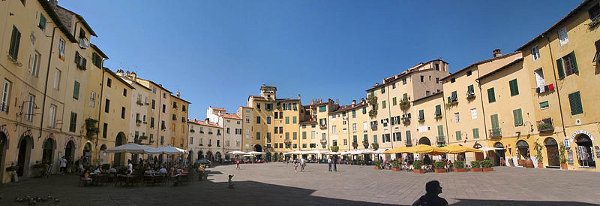
Lucca

Lucca is definitely one of the jewels of Tuscany, mindful of the great moments of splendor, arts, crafts, economy and culture. E '"the encircling the city" as he celebrated the unforgettable Gabriele D'Annunzio. The first traces of man found in the area lead back to the Ligurian people but with the Etruscans, like the rest of Tuscany and the Maremma low, you see a population increase combined with the economic and artistic growth, through trade and trade. The Etruscans and the Romans after they left valuable evidence, the remains of which are present all over the territory.

With the Romans in 89 BC, became the town hall and was perhaps the most intense period of turmoil that lasted about two centuries.

After the Romans it was the turn of the invaders took turns on the conquest of the Italian territory, and obviously suffered the same fate in Lucca, road junction of major roads. First came the Goths, then the Byzantines, the Lombards and later became a duchy and with whom strategic shift, and partly forced, down toward the valley of the Tiber to move to the other Lombard kingdom, Puglia.

Lucca became important in Tuscany thanks to the leader Castruccio Castracani to Paul Guinigi who started the artistic and cultural development. But the reputation of Lucca went beyond the Italian borders spreading its fame thanks to the intense and rich silk trade with l 'Europe and Asia.

In 1799, the city was conquered by the French and by Napoleon, became a principality of Happy Baiocchi and Elisa Bonaparte, sister of the Emperor, until 1814. After the fall nopoleonica, the Austrians held the state until the Congress of Vienna that gave the Duchy of Lucca, in Maria Luisa of Bourbon and his son Charles Louis.

In 1847, Carlo Ludovico gave the Duchy of Tuscany Leopoldo 11, but already in the air were those liberal ideas that would lead a few years later, to join him to Italy.


The University of minters is very old and was already present allíepoca of Lombard rule. Many documents kept in the archives of the Archbishop, documenting their activities. The "Moneturius" (minter) formed a corporation and under the protection of St. Eligio was called Collegium Monetariorum "which was headed by a" Monetae Magister (Master of Coin). All those who belonged to this University were called "Overieri" (those who make money) and admission was not easy because it involved the knowledge of art, as evidenced by their freshman and was made to swear on the Holy Gospels commitment to exercise rectitude the profession granted to Lucca by various emperors. In the premises of the Inquisition of the Mint of Lucca, the "College of minters" is active again with the ancient methods of refining, merge, cut through metal (secrets jealously guarded by a few families of Lucca, called "De lineage Monetae").

Our production is aimed at the reconstruction of the ancient coin reconstruction is done by studying more specimens of the same in weight, size and style so to get a design and a well detailed model, from which they are made punches males, engraved and worked burin. The old Inquisition of the Mint has made in Lucca, at its premises in Via S. Andrea 45 (near the tower Guinigi), an exhibition that traces the history of money over the centuries and can be visited on weekdays and holidays from 9.30 to 13 and 14.30 to 19 dolle except Monday morning.


Visit the villas of Lucca company is of no small importance if you plan to exhaust the discussion of this theme with an excursion for a specified time, you run the risk of usual underwent a 'smattering of news accompanied by a sequence of images that - while picturesque and charming - never going to give us back the full complex of cultural and environmental values ​​of that civilization in the villas of Lucca realizes that - together with the walled city - its highest expressive moment.

More than three hundred large and small are in fact the residences in the Lucchese villa is built over more than four centuries on the most beautiful places in the countryside and the arc of hills surrounding the plain of Lucca, from the early fourteenth century settlements were born as lodges hunting, through the great sixteenth-century villas of the affluent middle-class families engaged in art and in the silk trade, which drew the land and the environment as a superb natural setting, to the numerous imitators that the revival of those models completed the landscape - in later periods and up to the beginning of the twentieth century - with an interminable series of gentle and civilized traits, such as those offered to the visitor even more hasty. This heritage is still all in private hands, which he often passed from one generation to 'other with tender care that the Lucchese manifest in the things that they know are desdnate to stay, and through it is developing a new way to propose to 'external appreciation through the rebirth of hospitality, typical production, hospitality culture and the liberal arts. The visitor is thus faced with a limited repertoire of monuments, but a permanent witness of values ​​that includes architecture, landscape, agriculture, traditional activities, food and wine, and even recesses of quiet and meditation, contemplation and spiritual regeneration, enjoyment of the environment in corrupt, in which it is necessary to penetrate with progressive enthusiasm, without the feverish restlessness of tourist to time, seeking as the measure for each one proves to be more convenient. In other words, on tiptoe.

Says Borchardt, he clearly recognized the Lucca and long stays there: "The villa honors already far away to visitors, ripagandolo of all that denies him until he èsemplice tourist". Anyway, this trip must be organized in one or more paths, none of which - say it now - will be limited to the theme of the villas of Lucca, perhaps because the temptation would be to wander around aimlessly, following a wall of stones picked clean by the wind and surprisingly elegant meeting tables of ancient palaces hidden among the branches of trees, or enchanted by strong scents of the wine bubbling in the cellar and wait for the hills resolve the rosy sunsets. It is a journey that has few stages safe and is often entrusted to the initiative of the ancient character of the stranger, the once neglected mails to stop and investigate signs of civilization, choosing them in the vast panorama as in the apparently insignificant details and what drawing from the rest for the spirit that - at the end of the pilgrimage - gave him the certainty more returning better than when he left.


National Museum of Palazzo Mansi

It was purchased in 1965 by the Italian State as the venue for hosting the paintings of the national museums of Lucca.

National Museum of Palazzo Mansi

Via Galli Tassi, 43 - 0583/55570 - Fax 0583 / 31.22.21 - Opening 9/19 festive * 9/14 * closed on Mondays.


Cathedral Museum

E 'consists of a thirteenth century tower house, a sixteenth-century church and a main body of the fourteenth century. On display are works of art that have characterized the centuries attachment and devotion to the emblematic figure of the Holy Face - ancient crucifix venerated in the Middle Ages throughout Europe.

In the sacristy of the Cathedral is visible what until now was considered that the tomb of Jacopo della Quercia carved llaria the Wheelbarrow - wife of Paul Guinigi who was the lord of Lucca between 1400 and 1430.

Cathedral Museum - Via Archbishopric - 0583 49.05.30 - Open daily April / Oct 10/18 - Nov / Tue 10/14 - Holidays 10/17


Lucca still retains its entire mighty walls, created primarily to strike military and administrative organization, because no one ever tried to capture it. The walls can be covered as a walk under a century-old trees that were planted allíepoca to cover the view of the towers in case of attack, but also as a supply of firewood.

In the following centuries the circle of ramparts was transformed into a sort of hanging garden suspended over the city. For centuries, the people of Lucca there had illegally planted small gardens, I had sent to graze their horses, while the ditches were used as external wheat fields or pastures for their herds.

The walk up the wall preferably on foot or in a carriage divenutaa in the eighteenth century was a must when you received principles strangers and an event not to be missed in the monotonous days of the nobility during the summer.

Even today, the ancient walls of the Lucchese have managed to preserve, protect the city center from the chaos outside, enveloping charm of one of the most beautiful cities díItalia and visitors should not miss líebrezza you feel in a relaxing and scenic stroll traveled for centuries of history.


The Villas of Lucca

The beautiful villas that can be seen in the most evocative of the countryside of Lucca, were built in the course of more than four centuries. There are over three hundred, including some fourteenth-century born as hunting lodges, like other great sixteenth-century villas of middle-class families and wealthy merchants of silk.

This heritage is still all in private hands,

meticulously passed down from one generation to another and strictly as. Only some of these villas can be visited today and can offer a welcome worthy of the best traditions of Lucca.

The structural matrix and formal Lucca is the presence of the villas, including this sense the whole of the villa itself: the whole property consists of real estate from the main building, the park, the farm, the farm houses, from the agrarian , by the woods and waterways. "The villa is harmonic distinction of vineyards and olive groves, cultivated fields and wild areas, houses of peasants and abode of the Lord" (Isa Belli Barsali) is the work of an urban middle class that invested the fruit of their earnings in land. A set built as a work of art, from a people refined. But this landscape, so popular today, it is not only the result of an operation of investment land. In the structural organization of this territory everything was kept in mind: the position of the land, water regulation, the order of the crops, the placement of buildings, the layout of the trees with great simplicity, modesty, functionality, order, poise, rigor. A common matrix for the organization and its definition is given by the accommodation in terraces or knolls of the land. With this technique, transformed the grounds of steep hill in flat parts, preventing soil erosion and harnessing the waters, regimate, you convogliarono where the man wanted to. It is the grand design of the Tuscan hills, is "adorned the amphitheater of hills" Borchardt, a series of signs, parallel to each other, curvilinear, that shape variously, but with continuity, the local context of the villa, constitute the bottom. It 's the result of the struggle, or the dialogue between man and nature to force, or to convince her to productive use, in accordance with its structure. It is the result of a secular work of which there are, in Lucca, certain documents by the end of the thirteenth century. This distinctive landscape Lucca is no exception to that Montaigne in the Journal de Voyage, in 1580, wrote: "On ne peut trop loeur the utilité et la beauté de la méthode de cultiver qu'ils ont les Montagnes jusqu'à the peaks, en faisant y, en forme d'escalier ... ". In the relationship between settlement hills and crops, including villa, garden and landscape materials used also play a fundamental role: they are cooked on-site materials, such as brick kilns of the local (now all abandoned or demolished), limes prepared with limestone ceroid of Santa Maria del Giudice, sands and pebbles of the Serchio, the stones. It is precisely the stone materials to act as constitutive elements such as rags construction or as a cutting material, are used in the enclosure walls, the gates in the architecture, in pavements, in creases in the decorative bands, in the frames of doors and windows, in houses and oratories. The quarries of Matraia and Guamo were those that were addressed, one to the north, the other south almost to serve impartially two shares significant settlement of the villas. Yet the stones were also used together in dialogue with the brick, with their diversity of color. Sites rich in springs or served by a stream, with straightforward as possible derivations, were the ones most sought for the construction of the villas. The water in the villa, not only performs tasks related to the purely functional home life and agricultural work, became the occasion for the creation of works of embellishment and fun, of pure pleasure. The architecture of the water together with the architecture of the green form the micro-landscape inside the closed area of ​​the villa; reach the highest levels of quality and hydraulic technique found in the many water lilies, ponds and fish ponds, with games secrets of water, varied architectural solutions, enhanced by statues and decorations made of rustic mosaics, stones of various colors, shells, with grotesque and monstrous. What nymphaeums are important and also studied the play of light that penetrate inside of these architectures in which the light beams form rainbows with the dust of water. But the game, the pleasure reunite properly, in a sort of civic sense and respect, which is typical of the soul of Lucca, to his neighbor: the water is not dispersed, is not altered, can shut down the available to the other.

https://tuscanysea.com/backoffice/immagini/tuscanysea.com/-17-5-2013-11-28-281.jpg https://tuscanysea.com/backoffice/immagini/tuscanysea.com/-17-5-2013-11-28-282.jpg

by Valentina
Massa Marittima

Massa Marittima is one of the major tourist destinations of Tuscany and the city it is located in an area of ​​exceptional beauty and interest to the Metalliferous Hills.

Immersed in the Tuscan Maremma, 20 km from the sea, Massa Marittima, cultural center of the "Metalliferous Hills", is located at an altitude of 380 meters. The municipality covers an area of ​​284 km2 and has a population of about 8800 inhabitants, who lives in an area of ​​great natural beauty, with copses, maquis, fields dedicated to agriculture and grazing.

The Etruscans were the first to exploit the mining area and around 750 BC the extraction of minerals brought this people to be the richest in central Italy. The city of Populonia and Vetulonia drove the dominions to the Metalliferous Hills. Populonia drew wealth from the iron ore extracted from the fourth century BC, the island of Elba, from Vetulonia, however, left many of the locals to go and settle in the villages around the present Massa Marittima (so that, in the vicinity of the lake dell'Accesa, were found traces of this presence). In these lands were abundant mineral-rich silver and copper. And the discoveries made are evidence of continuity in the treatment of minerals, which is not much different from that of modern steel mills and foundries, have been found, in fact, remains of furnaces, and increasingly around the lake dell'Accesa, the foundations of a settlement the sixth century BC where they lived probably the leaders of a mine. The Etruscans transformed those minerals rich in gold, iron, silver, lead, copper, jewelry and objects of various use.

The excavations, conducted periodically since 1980, have brought to light, on the high south-east of the lake, many living quarters, which are only visible foundations of the buildings.

These nuclei comprising about ten houses each, usually two or three rooms. The construction technique was typical of Etruscan settlements: foundations of connected stones dry and raised brick raw or made with the technique of the trellis (wood poles, straw and clay); roof with roofing tiles, floor compact clay. In the village were found traces of activities related to the extraction and processing minerals, represented mainly by smelting slag.

The settlement, which has lasted for about a century (end of VII - beginning of the sixth century. BCE until the end of VI), depended on Vetulonia. Its end must be put in connection with the loss of control over mining areas by Vetulonia in favor of other centers, in particular of Populonia.

After the Etruscans, the Romans continued exploitation although to a lesser extent. With the barbarian invasions and the destruction of numerous villages, there was the abandonment of mines until the Middle Ages. The barbarian raids and those of pirates and Saracens down on their knees Populonia, whose diocese was transferred around the eleventh century, Massa.

The activity was resumed by the arrival of the Lombard masters, particularly comacini, labor Tyrolean Saxon and South Tyrol. Not surprisingly, Montieri, dominated by the Bishop of Volterra, in this period saw the increasing importance of own mines and Siena bought a part of the Silver Collection Montieri to mint coins. The extraction of minerals copper, zinc, lead and silver in particular, was therefore a significant boost in the medieval period.

The heyday as a mining center of Massa Marittima occurred between 1200 and 1350, for its heritage, in fact, was called "Mass Metallorum" (the city of metals). In 1225, the city became a free city, redeeming, by virtue of the wealth that came from its mines, the rule of the bishops and more than a hundred years he was able to maintain its independence.

It had its own mint, their weights and measures, and gave Europe the first Mining Code of the story: "Ordinamenta SUPER ART FOSSARUM RAMERIAE ARGENTERIAE CIVITAS Massai" (XIII century), wonderful example of legislation that regulated the exploitation of mining camps, witness the very high degree of development reached by the country both in terms of legal capacity in the management of subsoil resources.

From the middle of the fourteenth century. wars, plagues, subjection to Siena for four centuries put an end to mining in Maremma, the Republic of Siena and later the Medici, when they take the place of power, considered the region as a colony and reduced it to a state of extreme degradation.

Only since about 1830 the area entered a recovery phase, mainly due to the extensive reforms and remediation action undertaken by Lorraine. It was the Grand Duke Leopold II, who released the concessions for the first attempts to study mining in the area: these resulted in failures because the adverse environmental conditions, still plagued by malaria, never allowed to achieve concrete results even after fruitful research. Starting from 1860 a company was finally born, the "Phoenix Massetana'', which exploited profitably in the veins of pyrite in the lake area Accesa.

At the end of the century appeared in the Maremma "Montecatini Company" (which took its name from its first mine, located in Montecatini Val di Cecina, in the province of Pisa), which in a short time acquired the majority of the mines of the district and it increased the production boosting, over the years, to a chemical that used the first product from the processing of pyrite: sulfuric acid.

The rest is recent history: the mines were for decades the backbone of the local economy, which was based almost entirely on the mining and processing activities on the side of the sulphides, and this sector has undergone a period of serious decline, the mines were all closed and Massa Marittima is trying to revive its economy with tourism.

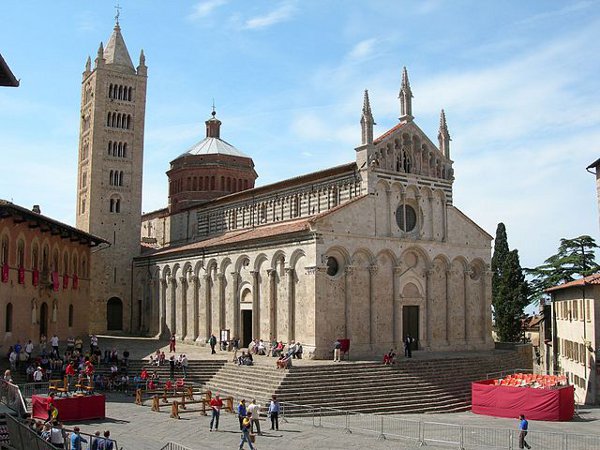
Visiting the city meet the monuments and buildings of extreme particularity, such as the Cathedral of San Cerbone, which was built in 1200 in Romanesque style, today houses a number of important works of art, like a stained glass window made in 1300 representing the Redeemer in Glory and Stories San Cerbone, also a fresco dating back to the fourteenth century and depicting the Madonna and Child Enthroned, frescoes which have as their subject the Crucifixion, the Madonna in Glory with Saints Joseph and Bernard with two monks, attributed to Nasini, San Cerbone with Geese; inside the Cathedral are also a baptismal font, some columns topped by figures of a Griffon, a man with a beard and a horse, a wooden Crucifix by Giovanni Pisano and finally as many as 11 small statues depicting saints and prophets, who along with some frescoes are found in the crypt.

On the square in front of the cathedral are also the Praetorian Palace, built in the thirteenth century, the Palace of the Counts Biserno and the Medieval Palace of the City, one of the main peculiarities of the Tuscan city is to be divided into two parts: the oldest part, surrounded by walls is the Old Town, within which we find the House of San Bernardino and the Palazzina della Zecca, old building where the coins were minted, while, outside the walls meet the Church of San Francesco, in style Gothic, the Church of St. Augustine, the Church of San Rocco, built around 1400, and finally the Renaissance Palace of Arms, which are instead the New Town.

Many museums have been set up in Massa Marittima: the Archaeological Museum, the Mining Museum, the Museum of Art and History of the Mine, the Archaeological Park of Lake dell'Accesa, the Old Mill and Old Joinery.

The origins of the city are to be placed in the Middle Ages, it was built in the territory of Mount Royal and around Mille assumed considerable importance and became a bishopric; Massa Marittima later became the Free City, but it was still conquered and controlled by Pisa, Siena and Florence, under the dominion of which became part of the possessions of the Grand Duchy of Tuscany.

Another element of pride for the city is definitely the award of the Medal of Military Valour, for the courage and the activity of the population in the years of the Second World War.

The city is also famous for its wine DOC, the Monteregio of Massa Marittima, consisting for the most part on the type of Sangiovese and Trebbiano Toscano red for white; famous desserts are also being produced in Massa Marittima, as Panforte, the Seahorses and Ricciarelli.


Quick guide for the search of its solutions for holidays in Cecina.

Those who approach the idea of ​​spending his holidays in Massa Marittima will need to consult a guide to find hotels in Massa Marittima Massa Marittima Hotels or hotels Cecina.


For those in search of the substance and a room can be enough rooms or rooms holiday accommodation Tuscany Coast Tuscany or even rooms for rent Tuscany should be appropriate search terms as well as rooms Massa Marittima.


The Italianists prefer to look for hotels or hotels on the Tuscan coast in Tuscany.


Should nonetheless be acknowledged that Massa Marittima is located on the Etruscan Coast, which is in fact in Tuscany sea, and the Coast Tuscany is unique in the world.


Given that in recent years tourism has largely shown a preference for solutions besides housing type hotel, residences Massa Marittima Massa Marittima holiday apartments, holiday apartments in the Tuscan coastline, have become frequent rumors of research on texts on the Tuscan coast tourism guide .


It is also for this second chapter as previously said about the Etruscan Coast, then in reading pamphlets on Massa Marittima or even where to sleep only to be sought in Tuscany or type the entries residence Massa Marittima Massa Marittima apartments, hotels or even Cecina hotels Massa Marittima.


Then refer to the Help in the Tuscan coast hotels will be well oriented to the voice holidays Tuscan coast and search for hotels in the fen or, if you prefer, hotels Tuscany Coast.


The search for residence on the Tuscan Coast could be profitable since the topic is more general summer holiday in Tuscany, apartments for rent, seaside tuscany, holidays on the sea.


It is not to be neglected even the search for rooms Massa Marittima, in the end we are talking about Tuscany Italy, holiday apartment Tuscany, someone with more economic means seeking Villa Massa Marittima or even Tuscan coast villa rentals Massa Marittima.


For those who opted for a specific area such as the Etruscan Coast Cecina or in a particular way, it will be well to remember that the search terms to be extended in Massa Marittima studios besides vacation rental Tuscany Tuscany or even sea or cottages Massa Marittima.


Finally, not least, we must remember 's Farm or Tuscany Farmhouses Tuscany.


So let's look at farm Massa Marittima.


Then there is the chapter of the holiday apartment very popular among couples and even by couples with a baby. Studios for rent Tuscany is therefore a search term very profitable, as well as studio apartments or houses Tuscany Massa Marittima.

https://tuscanysea.com/backoffice/immagini/tuscanysea.com/25-17-5-2013-11-30-321.jpg

by Valentina
Meloria

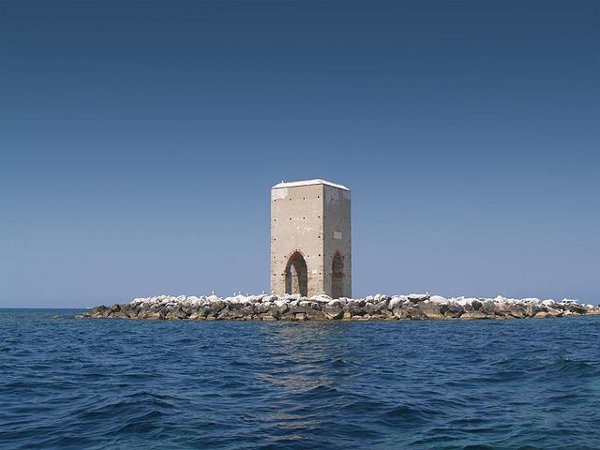
An islet, or more exactly a rocky outcrop surrounded by cliffs above the water in the Upper Tyrrhenian Sea, nine kilometers long and two wide, in front of Livorno which is just a short distance to the sea: this is the Meloria, famous for the battle of August 6, 1284 which marked the great defeat of the Pisan fleet perpetrated by the Genoese. But the Meloria is also a place, from antiquity to the present, for the extraordinary landscape and nature, for morphological details that distinguish it. In this book, a famous explorer of the exotic seas of the Mediterranean and in particular, how Folco Quilici, a historic student of Marco Tangheroni as Olimpia Vaccari, a naturalist and Livorno, such as Gianfranco Barsotti, who Meloria and nature below the its sea knows all, we return to this place that belongs to the collective of the civilizations of the Mediterranean's most important aspects. The book also in the photographs of Fabio Jackdaw, for the emerged part, and William Cicerchia and Federico Fiorillo, for the submerged part, amazing images and highly suggestive.


Cursed meloria

Renzo Castelli

The defeat still burns with Genoa, seven centuries later. Maybe it's time to get over it ... I'm not rooting athlete nor traditions are often a little 'fake driven by tourism, to draw the very soul of a city. In the case of Pisa, his "pisanità." In a few cities, like this one, the story, and then the remote past, have left their mark so marked and conditioning. Pisa has too much memory - the Etruscan origin, the size of its navy - to forget. That's why even today the Meloria is not only the name of a battle ended in defeat, one of many that man has fought on land and sea, but it is the death of a city-state, the humiliation of its citizens. With the Meloria (1284) Pisa has lost her pride, dreams, royalty, and never will forget the lost power. The city-state he bowed his head, perhaps forever, and never forget again. Pisa, which had been (Rudolf Borchardt) "an empire of sails", it remains for ever and ever defeat a city, humiliated, disappointed. Pisa, or wounded pride. It was not just Meloria to dig the large groove that casts its shadow down to us. For the 12,000 dead of the battle that wiped out the soul of the great city-states, were joined by 6 thousand prisoners brought in chains in the prison Genoese module that caused a demographic crisis that seemed irreparable. "This situation - says the historian Emilio Tolaini - led to a sharp increase immigrativo from the country that made it possible to reconstruct in some way the network traffic." But the return to a seminormalità was not true glory: just a century later, in fact, the Florentines buy Pisa and its port.

If it is true that every city has its own soul which is the result of the souls of those who have always lived, many agree that Pisa still a sullenness is the daughter of the most stinging defeat. Grumpy therefore, proud that he judged Borchardt in the last century, and the judgment still stands. For these reasons, nell'effervescente and inventive Tuscany, in the blasphemous, Pisa is placed with different characters from every other tower. The "pisanità", even today, it means mistrust because distrust is the daughter of wounded pride. Not by chance Curzio Malaparte, in designing its Cursed Tuscans, glissò entirely of Pisa. He confessed: "I do not understand them, they Pisa. They have a character evasive, disingenuous. It almost seems like something that should be forgiven. But what? ". The answer would be the same today: to be forgiven to have lost. Yet Malaparte loved Pisa, nightclubs as well as its silences the voices of the students, the extraordinary beauty of the marble and the Arno river that flowed to the sea. Although preferred that river and the ice storms of winter because the "peat" meant the entrance into the EEC Arno. And for a plate of EEC consumed in Piazza Garibaldi, at the inn of the Nile Montanari, Malaparte would have given up the ghost. (Do not know what are the EEC? We can not explain it: come to Pisa and you'll understand). And with the innkeeper friend, Malaparte confided: "You are a strange breed, but cooked well."

Dante saw to his own time and with some effectiveness to denounce the horrible guilt of Pisa. After Meloria, Count Ugolino della Gherardesca held liable for incompetence or betrayal of that defeat, he was locked up to starve to death, with his sons and grandsons in the historic tower in Piazza delle Sette Vie (today, the Knights of St. Stefano). The Dante's invective is strong, but if the poet had known the result would have written things even worse. The bones of Count Ugolino, in fact, were later buried in the face to the river along the river Tramontana and that land remained forever cursed. Who Tread today visit Pisa and its riversides, will find that long line of buildings is interrupted, just before the church of the Holy Sepulchre, by a garden, the only one that can appear on the embankment. But it is not a garden, and there is a cemetery: it is cursed land. Why not forget the people of Pisa. Even today the bones of the count found peace - hopefully - in the convent of St. Francis, on that land will never be allowed to build anything.

No, Pisa can not be considered a city "normal", as well understood Malaparte. Says Professor Silvano Burgalassi, a sociologist and expert on most of the soul of Pisa "Pisa lives of the past and unable to express the values ​​of art, spirituality, intelligence of which also bears. It is a kind of brake, almost a curse, which does not know how to free. Today we could no longer do the Piazza del Duomo or riversides because it would lack the ability of inspiration that were the Pisans before Meloria, when they ruled the seas and saw their mission in this divine something that should be celebrated with dignity. Since then, the soul of Pisa is suffering from wounded pride and is not capable of expressing a depth of thought that is in tune with their times. "

Yet Pisa today would have much to brag about. It has all the requirements to be a happy city: a mild climate, the sea six miles, the hill to seven, the mountain for skiing less than an hour, it has a central position, an international airport, a port (the "port of Pisa", which some call Livorno) at 20 kilometers, has three prestigious universities and one of the largest national nuclei of the CNR, he finally museums and monuments around the world envies us. But it is not a happy city.

How much will have to go because Pisa recover its serenity, forget his defeat and his empire lost, because the "pisanità" finally becomes a positive feeling? No one can say. But it will not be the folklore to heal the wounded pride. The Pisan contemporaries in shadow that simulates a false folklore, once a year, the glory of a maritime republic that no longer exists. Indeed, consider that race a little 'blasphemous, a comparison of muscular athletes who do not have the right to evoke the splendor of an era.

Yet the "pisanità" sick, this grumpy mood, this malaise of the present, often escapes to visitors. If Malaparte was wary of Pisa and Pisa, other visitors instead found a great serenity in the silence of the city, in its pathos.

Elizabeth Barrett wrote: "Pisa, here is a small, charming town of silence. Sleepy streets where grass grows between the stones, where groups of boys frolic in solitude. " Seen by others, Pisa can really look like, tender and silent rather than haughty and sullen. And then, tormented souls, Pisa can be ideal: if his wounded pride is not apparent, it remains untouched by the fragrant golden oasis that reigns in the streets and squares, so that Shelley could find the inspiration for the comporvi ' In elegy death of Keats and Leopardi write in an April night, the scent of wisteria, poetry A Silvia.

by Valentina
Montenero

The Sanctuary of Montenero


Montenero, placed on a hill overlooking the sea and the port of Livorno, is among the hills of Tuscany's most famous especially due to its famous shrine dedicated to Our Lady of Grace. It is said that a shepherd cripple, around 1345, he found a miraculous image and asked to be transported on the hill of Montenero. Heard the voice of the shepherd did as he was told and got to the top of the hill he found himself cured. Since then, that image of the Madonna has never ceased to be a source of devotion and grace for all those who are turning and the Sanctuary that is born is a place of pilgrimage and visits by a large number of people.


Origins

The origins of the shrine dates back to May 15, 1345, the feast of Pentecost, when, according to tradition, a poor crippled shepherd found the miraculous image of the Virgin Mary and following inner intuition led her on the hill of Montenero, a place already known as a refuge of brigands and considered for this dark, gloomy ... the "mountain of the devil."

Beyond the many legends surrounding the history of the discovery of the image of the Madonna, which critics attributed instead to a certain Jacopo di Michele Gera said, it seems that image appearance in Montenero following a revival of religious fervor, around to 1341. In this year of the inhabitants of Livorno, then little more than a fishing village, would organize a cult of self-sacred images painted recently, however, opposed the ecclesiastical authorities intimated that the cessation of worship, and the disappearance of its images. We can not exclude that in front of this hostility, the image was hidden and later found near the shore of the river Ardenzo'''', from that zealous pastor who took her to the top of the mountain in order to entrust almost certainly the custody of some hermit .

The history

The fame of the miracle spread quickly, because of the many graces made by the Blessed Virgin and the pilgrimages begin with they are on the increase for the small chapel that houses the Madonna. Already in 1380 work began to expand the chapel and premises that served to protect the pilgrims. For the first custodians of the shrine, almost certainly the friars tertiary, followed in the cases of the Jesuits (1442-1668) and Teatini (1668-1792) then indicated as the most qualified to perform the service in the Sanctuary. In fact, in 1720, work began on the Theatines expansion of the Sanctuary which was finished in 1774. During this time, Our Lady of Montenero worked some miracles in favor of the entire city including the one in 1742 when the city was devastated by an earthquake and once again rescued by his patron and his image which was brought to the city and placed in front of the Collegiate. In Livorno that miracle was never forgotten much that is renewed every year the hope that the Livorno made to Our Lady "... to fast in perpetuity January 27, of no dancing, no masks, to assist in the Collegiate same all'annua function ... thanks.'' In 1792 the sanctuary was entrusted to the Benedictine monks of Vallombrosa which are currently the custodians.


Montenero is among the places of Tuscany's most famous especially due to the presence of the Sanctuary. Set on a hill at 300 m asl, Montenero has a wide horizon of the sea and land area of ​​outstanding beauty. Awesome views open before the eyes of observers. From here you can look down to the rock of Meloria, memorable for the betrayal of Count Ugolino (1284) and the famous battle between Genoa and Pisa, but also the plain with its Port of Livorno and that of Pisa. To the south you can see the island of Elba, Corsica and Sardinia: its wonderful sunsets. The name "Montenero" is due to an old famous saying this resort mountain dark, perhaps because covered with jagged ridges and infested with robbers who, in all probability, here waiting for the arrival of ships to which the assault. Montenero joined Livorno with a bus and a funicular that goes up to the square in front of the Sanctuary. The upper square was created by monks in the last century almost atrium discovered the Sanctuary itself. On one side stands the facade of the church, across the street Famedio: chapels that contain the mortal remains of large Livorno such as Guerazzi, Marradi, Meyer, Castles, Farms and a plaque in memory of Pietro Mascagni and Amedeo Modigliani.

L '8th September the festival being felt in the pilgrimage of the locals which is uninterrupted and the shrine is lit up at night after night Marian procession from the Chapel of the Apparition at the Shrine itself.

The Chapel of the Apparition

Located just before the Carriage Square, is the place where the tradition dates back to the discovery of the image of Our Lady of Montenero by a shepherd. Built in 1956, the larger and more beautiful than the pre-existing in the same place where he was the'' Chapel "partially destroyed during the last war (1943).


Church

The Church in Baroque style, very charming and inviting to meditation and prayer. On the main altar stands the Sacred Image of Mary in a marble shrine surrounded by a golden halo. The image of the Virgin, attributed to the school of Pisa and in particular to Jacopo di Michele said Gera, is painted on canvas superimposed at the table. The Virgin with the red robe and blue mantle, is sitting on a pillow and around the head is the word "Ave Maria Mater Christi". The face is tilted toward the child who sits with her hands in her lap clinging to the mother's robe, holding a thread that binds the bird gently on the arm of Mary, as if to indicate that faith is like a thread that draws the salvation Christ which keeps us united devotion of Our Lady.

Other important works of art are the Dome of the Church and the Tele side altars. In the dome, restored in 1992, is represented in the Paradise feast for the highest glorification of Mary, crowned Queen of men and of angels. The painting, executed in 1773, is the work of the famous master Traballesi. In the wonderful scenery saints and angels appear with Old Testament characters: Adam and Eve, David, Daniel, Aaron, Moses, Samson etc. up to St. Joseph, St. John the Baptist, St. Anna S. Cecilia and other martyrs. The most important are the Tele instead of San Giovanni Gualberto, founder of Vallombrosa, in the second altar on the right. The Canvas by an unknown artist depicts the saint in prayer in the background of the heights of Vallombrosa, the feet with the abbey founded by him. Another Canvas, located in the third altar on the right, depicting the Assumption of Mary and is the work of Philip teatino Galletti. In the bottom of the canvas, in the center, there is a niche in which is guarded, well-preserved a crucifix which is assumed to have been originally in a cave in the place Hermit, overgrown cliff on the sea coast near Livorno. On the sides of the Virgin are represented the Apostle St. Peter and the S. teatino Andrew Avellino. Always Galletti is the painting of Our Lady appeared to St. Gaetano Thiene, and presented the Child Jesus was solemnly inaugurated in 1696 on the feast of the Name of Mary.

by Valentina
Castellina Marittima

The first historical evidence of Castellina start with a household Etrusco Salivolpi place on the hill where there are currently visible an artesian well and the remains of the wall of the settlement. The nearby mound of Mount Calvary with four chamber tombs prepared to cross to the cardinal points, endorse the idea of ​​the importance of the site in the seventh and sixth centuries BC .

Relevant entities of the necropolis of Poggino in Fonterutoli brought to light a few years ago by the local Archaeological Group. The village of Castellina, in the current lease, has probably of Roman origin, but seems lost over the centuries, to the importance strategic - military had in the Middle Ages. The story of the Castellina Trebbiesi century, the name given by the nobles of Trebbio the coterie of the Counts Guidi, owners of a nearby castle whose remains are visible from Badiola labile. In the twelfth century it became an important military stronghold of Florence, situated on the border between the states of Florence and Siena. The main center of the 'old with the League of Chianti Radda and Gaiole in the thirteenth century later, in the fourteenth and fifteenth centuries Castellina is the scene of raids and attacks by the state of Siena. These events forced the Florentines to be put in place continuous restructuring and reinforcement of the walls entrusting the supervision of works by famous architects such as Filippo Brunelleschi.

In 1478, while Florence is at war because of the conspiracy of the Pazzi, in Castellina is sent Giuliano da Sangallo restore strong defense structures: in this episode there is a comprehensive chronicle in the "Lives" by Vasari. Baldassare Castiglione in his "Courier" instead describes a siege of forty days by the Duke of Calabria, opponent Medici, where they were used as the artiglieriedell'epoca bombards, catapults and projectiles "medicated" capable of causing epidemics and plagues. After the end of the war back to Castellina Florentine Medici in 1483. In the sixteenth century, the country lost its strategic importance. The war between Siena and Florence is finished and in the unification of the Grand Duchy of Tuscany Cosimo I de 'Medici transforms the old military outpost in rural center structured according to the canons of the farm as sharecroppers. In 1865 he founded the town of Castellina and its headquarters were moved in 1927 in the restored medieval fortress of the town square. The Second World War saw the country scene of the passage of the front. The bombing destroyed the ancient Porta Fiorentina at the extreme north of Via Ferruccio and the adjacent parish church was seriously damaged facade and bell tower are rebuilt and modified in its present form at the end of the conflict

https://tuscanysea.com/backoffice/immagini/tuscanysea.com/16-17-5-2013-10-42-201.jpg https://tuscanysea.com/backoffice/immagini/tuscanysea.com/16-17-5-2013-10-42-202.jpg

by Valentina
Castagneto Carducci

Castagneto Carducci, a small village once surrounded by walls, is located on top of a hill, dominated by the Castle of the Counts of Gherardesca. The city center is developed in a pattern of concentric rings that result in a set of streets, alleys and squares that show in the past, of which we can still find some old testimonies. Castagneto, which also includes the towns of Bolgheri, Marina di Donoratico Donoratico and brings together in its territory a wide variety of natural environments: the beach, the pine forests of the coast, the areas that are reminiscent of the ancient Maremma, the countryside dotted with villas, the farms and houses, the hills by the shapes and colors typical Tuscan cuisine, the ancient alleys of the country.

by Valentina
Casale Marittimo

Feature is its semi-circular ring structure that descend gently towards the sea, corresponding to the many stages of urban development. And 'one of the countries that best Cecina Go to maintain the layout of the medieval castle. On the territory have been found remains of Etruscan and Roman settlements, of which some remains can be seen in the country.

The hills of Casale were places of Etruscan settlements and several archaeological finds were made in territorio.Il most important is a tholos tomb, of the fifth century BC, removed and rebuilt in the garden of the Archaeological Museum of Florence. Come from this tomb, among other things, the two oldest objects in alabaster which has been known, probably left from the workshops of Volterra - a patera and a lacrimatoio -, also the Archaeological Museum of Florence. Other exhibits in museums of Volterra and Cecina Fifty. The Roman era is a small villa in Botro della Pieve, the materials of which were reused in some buildings of the country.

The medieval castle is named in documents since 1004 and belonged to the Counts of Gherardesca, which refer to the first documents of sale (in 1004 Gerard and his wife Julia gave it a church and 13 farms "that are in the court of Casale" to the monastery Santa Maria Serena in Chiusdino, in 1008 Gherardo of Gherardo was sold homes, farms and household goods of the district of the parish of St. John of Casale, and Wilda, his wife, other property in the same district, in 1092 a Count Gherardo granted to the monastery Montescudaio a church of Sant'Andrea in Casale).

In fact there were two castles in the area of ​​the same name: Casalvecchio, which remained the only hill of the same name in the southeast of the country, and Casalnuovo, today Casale Maritime. It is not clear what the relationship between the two castles and how long they lived together; oldest documents are certainly to refer to Casalvecchio, and so also a famous letter from the bishop of Volterra, in 1344, in which these tells how the Count Gherardo di Donoratico were sick in the castle of Casale and because of poor air could not heal until they had been taken elsewhere: "We sent them doctors [...] and those advised him because the air of Casale was corrupt and of other reasons that if there is not it proceeded, that he was in jeopardy of life and truly according to which 'doctors we were then told that sickness would not be unsubstantiated if it was not party. " And 'This is an early witness to the spread of malaria.

Casalvecchio presumably was destroyed in 1363 during a battle between Pisa and Florence, but probably even before it was gradually abandoned in favor of Casalnuovo that, although not the highest, it was better ventilated and more healthy.

Between the two castles on Botro della Pieve, was the parish church of St. John the Baptist of Casale, which still gives its name to the river and a location. It was the mother church of the surrounding, the only one with a baptismal font, and she did not just head Casalvecchio and Casalnuovo, but also Guardistaiio and Montescadaio. Although it was heavily damaged - in fact, "[...] almost demolished et destructa totum" in the fighting of 1363 and the baptismal font as a result of this war had been transferred to Casalnuovo - it held the title of parish and kept it , apparently, even until the middle of the '500. In 1413, at the time of a pastoral visit of the Bishop of Volterra, it turned out "in totum ruined," that is totally ruined and only the walls were standing, but he was parish and the parish priest. In 1439 the baptisms of all the children of the neighboring castles were held "every Holy Saturday at the baptismal font in the parish of St. John the Baptist in Santo Andrea Casale," as can be seen from a letter from the Bishop of Volterra, which shows that Sant 'Andrea housed the baptismal font but do not have the title of parish. While the castles of Casale were under the political domination of the Republic of Pisa, the church depended on the diocese of Volterra.

A Casalvecchio lived from about half of the '300 Montescudaio accounts, branch of the family Gherardesca formed at that time in the castle of Montescudaio. One of their palace or fortress still existed in the nineteenth century and is named in the Gazetteer of Repetti. The structure of the castle was a circular plan with a door to the south and antiporti provided with access ramp and dominated by the fortress. To the north was a lookout tower, still visible, but they are not proven other ports. The walls were formed by the same houses they had, and have, very thick walls to the outside and few windows placed only at the top. Inside - as in other medieval settlements - the houses were huddled together without any rule and no respect for the progression of the roads and lack of sufficient aeration. The castle contained within it not only the houses and cellars, the shops of the butcher, the blacksmith, the barber, the oven and the mill, but also the stables and forts for domestic animals (donkeys, pigs, chickens) and some vegetable garden. In addition there was the church with the adjoining cemetery and, in addition to the mansion with stables, stables and warehouses, were the court room and prisons. Outside the walls remained the source with the watering and washing. The church was dedicated to St. Andrew Casalnuovo and is named for the first time in 1305.

In 1406, following the conquest of Pisa from Florence, Casale also, like other countries of the Val di Cecina, submitted to the Florentine Republic. In 1407 he obtained permission from Florence to form a municipality, but contrary to what happened in Montescudaio Guardistallo, could not free himself from the accounts of Gherardesca-Montescudaio who kept their property and jurisdiction. The small community did not give immediately the statutes, but in 1414 he accepted those Montescudaio Guardistallo and also afterwards, since 1490 until 1620, its statutes were always included in those of the other two municipalities.

On the sixteenth and seventeenth centuries are reports of some interest; centuries are characterized by the defense against pirate raids, the fight against malaria which infested the coastal plain and dated back to the countries from periodic famines and epidemics and the social and economic stagnation characterized in these areas the Medici Grand Duchy. All these factors have definitely made it difficult living conditions of the population.

In 1551, Casale had 245 inhabitants.

1642 is the news that the community decided on the fortification of the walls to defend against pirate raids from the sea. In 1648, in the wake of Montescudaio, Casale was given in fief to the Ridolfi and in 1738 became part of the Marquis of Riparbella, given in fief to Count Carlo Ginori.

At the beginning of the eighteenth century campaigns were in a state of extreme poverty and backwardness. Vast lands of the vassal remained reserved for hunting and the woods were advancing. In 1709 "was proposed as it would have been necessary to have the opportunity of a doctor, given the bad air, and indexable patients often die miserably without experiences." Nevertheless Casale was probably in better shape than many other countries since the Targioni Tozzetti, who visited in 1742, he wrote: "Casale modern age is the biggest, and most of all healthy Castle Marquis. The reason of health is not only a nearby water fountain good, as well as the favorable situation in a transport of high hill, and well ventilated. " In 1745 the inhabitants were 315.

In 1777, with the reforms of the Grand Duke Peter Leopold, began the process of land redistribution and, consequently, their centralization in the hands of some new wealthy families: Casale emerged in the names of the Chancellors, the Sparapani, the Werewolves and Marchionneschi, which as a result have held power in the town throughout the nineteenth century and into the first half of our century. The concentration of land and the spread of the system of sharecropping led to an increase and an improvement in agricultural production. In the nineteenth century was still raging malaria, there were no houses in the countryside, the wolves were so abundant that in 1810 a government decree freeing the hunting of wolves from any constraint, but the number of inhabitants in the country began to rise: they were 817 in 1833 and twenty years later, in 1854, amounted to 1,070 units in 1861, the number had risen to 1,174. The progressive reclamation of coastal marsh favored agricultural development.

In the second half of the nineteenth century the town underwent some major changes due to the increase of the population in 1854 was demolished to build the southern gateway to the Civic Tower with the clock, in 1872 began the construction of the new church, which involved the ' demolition of part of the wall and the old town hall to open a passage to the new road. The old church was converted into a town hall. The cemetery disappeared under the new bell tower, but already in 1855 it was opened a new cemetery on the road to Guardistallo. At the same time the village had grown even outside the walls and 900 was placed at the beginning of the Piazza del Popolo, then square Chancellors. The country assumed more or less its present appearance.

In 1862, Casale, until then known as "Farmhouse in Maremma", took the name of "House of VaI di Cecina" from 1900 is called "Casale Maritime." In 1936 the number of inhabitants has reached the maximum limit of 1,583, but in the 50s began the process of migration to cities in the plains that were rapidly developing and guaranteed secure jobs, scheduled times lighter work of those requests to the tenant in the country.

In the early 60's the phenomenon of the earth was at its peak and the system of sharecropping was disappearing. Especially young people, they settled in the plains or migrated to the cities of northern Italy.

In 1971 the number of inhabitants had fallen to 837. The risk of becoming an "old country" was mitigated only by the fact that many inhabitants risanavano, with the money earned outside the houses of the village, accompanied by modern comforts.

Today Casale has 914 inhabitants. The economy is primarily agricultural and produce wine, olive oil and cereals, there are also a company of beekeeping, a laboratory of furs and other commercial services and dining options. The appearance of the medieval town is well preserved and awareness for the historical values ​​has meant that some modernization of the 60s have been removed, such as coverage of streets in the asphalt that was removed in 1989 by rediscovering the old paved with sandstone .


Taken from the Guide to the Val di Cecina, curated by Susanne Mordhorst, New Image Publishing

https://tuscanysea.com/backoffice/immagini/tuscanysea.com/14-17-5-2013-10-36-161.jpg https://tuscanysea.com/backoffice/immagini/tuscanysea.com/14-17-5-2013-10-36-162.jpg

by Valentina
Campiglia Marittima

Medieval village that still preserves within its walls numerous historical. And 'situated on the top of a hill (280 m asl) covered with olive trees and Mediterranean vegetation that dominates the Val di Cornia until the sea which is not more than 5 km. The modern expression of Campiglia is represented by Venturina, an agricultural center developed recently in the plain below, near which there are hot springs with curative properties.

We are in the extreme south of the province of Livorno, in that part of Tuscany that was anciently called Maremma Pisa. Leaving the Via Aurelia at the junction of Venturina, or near St. Vincent, and penetrating eastward through olive groves and verdant Mediterranean, after a few kilometers, on the top of a hill not far from the sea, appears Campiglia Marittima.

The nearby Archaeological Park-mining Rocca di San Silvestro, a site of great historical and cultural importance archeominerario. The fortified village, which today we can admire the remains, was built in the X century. under the rule of the Counts of Gherardesca.

https://tuscanysea.com/backoffice/immagini/tuscanysea.com/13-17-5-2013-10-28-91.jpg https://tuscanysea.com/backoffice/immagini/tuscanysea.com/13-17-5-2013-10-28-92.jpg

by Valentina

Bolgheri - Castagneto Carducci


From Bolgheri in a few kilometers, driving through a gentle climb, we arrive at the delightful village of Castagneto Carducci is named after the great poet who lived here in his youth. With its walls and its medieval, Castagneto Carducci is worth a visit relaxed. The castle belonged to the Gherardesca, has been renovated several times and now has the form of a mansion. Further among the narrow streets of the village cakes meets the seventeenth-century oratory of SS. Crucifix on the main altar preserves a thrilling wooden crucifix of the Pisan school of '400. Carducci lovers will be happy to know that Castagneto was named "Literary Park" in 1995. Among his most obvious is Espinasse Moratti Palace, which was home to the poet until 1849. But Castagneto also offers a special meeting craftsmanship: the renowned workshop "Art and Fashion" of Moranti for decades sews and packages tailored Casentini, safari and hunting clothes unmistakable elegance with fabrics ranging from raw silk to cotton khaki, the stupendous velvets. Gorgeous clothes and unobtainable elsewhere, requested by celebrities around the world (Art and Fashion Florin Cristea, tel. 0565.763694).

You can combine a visit to Castagneto Carducci half a day at the beach in Marina di Castagneto, together with Marina di Donoratico, offers a sandy beach sheltered by a dense pine forest. And finally you can dine in style at Bambolo (The Bambolo, tel. 0565.775206) or back to Castagneto and enjoy pancakes with ricotta cheese and rosemary pigeon in good, local restaurant Bagnoli (Bagnoli Restaurant, tel. 0565.763630).


Sightseeing in Castagneto Carducci

Gherardesca Castle, Rectory of St. Lawrence, Church of SS Crucifix, Church of Our Lady of Mount Carmel, Center Carducci (Via Carducci, 59), Museum Archives, Piazzale Belvedere


Oasis "Marsh Wildlife Refuge in Bolgheri"

"Marquis Mario Incisa della Rocchetta


Where and how to get there:

In Tuscany, the Municipality of Castagneto Carducci (LI).

Coming from the North: Exit California on Aurelia, continue south, came to the church of San Guido Bolgheri, we proceed further towards the south beyond the beginning of the cypress avenue at about 500 mt .. On the right. Oasis entrance.

Coming from the South: Exit Donoratico Castagneto Carducci on Aurelia, continue north, after about 8 km away., 500 mt. before the Cypress Avenue entrance on the left Oasis.

Extension: 513 acres

Management: Agreement between the property Engraved della Rocchetta and WWF Italy.

Environment: ditto

Flora and Fauna: sandy coastline is home to species psammophilous characteristics (sea lily, sea Sea Holly) while the coastal dune Juniper cuddly, Phoenician juniper, pine, Mastic, Holm; hydric wood with Ash leaved behind the dunes, seasonal ponds more or less extended, wet meadows and cultivated areas.

The Oasis offers winter refuge, among others, Teal, Wigeon, Shoveler, Pintail, Gadwall, Mallard, Greylag Goose (symbol of the oasis), Crane, Pilgrim, Pigeon, Dove, Lapwing and Golden Plover. In spring Pitti

but real, Fighter, Knight of Italy, Purple Heron, Bittern, Bee-eater.

Nesting Lesser Spotted Woodpecker, Treecreeper, Green Woodpecker, breasted, Cuckoo, Nightingale. Among the mammals are present: Fallow Deer, Roe Deer, Wild Boar, Porcupine, Badger, Wild Rabbit, Hare. Among the reptiles: marsh tortoise, Grass Snake, Viper, lizard.

Facilities: Visiting the museum with 6 observers and a lookout tower. Nature trail for schools with two observers.

Views and useful numbers: open from October 15 to May 31. Visiting hours :9,00-12, 00 14.00-16.30. Views EVERY FRIDAY 'and Saturday. Group and school on TUESDAY '. The tours are guided. It requires the utmost punctuality.

E 'must be booked at the Section WWF Piombino - Val di Cornia

Tel / fax 0565-224361 e-mail: wwfpiomb@tin.it


L'Oasi di Bolgheri.


Fulco Pratesi, president of the Italian WWF in 1984 wrote, "In the beginning there was Bolgheri. WWF Then came the Italian."

In 1959, Mario Incisa della Rocchetta decided to transform 60 acres of marsh, and 453 acres of pastures and cultivated fields that surround them in the first Italian private oasis. In 1966 he became, with the Oasis of Burano, the first Italian oasis. The same year, the Marquis' with Fulco Pratesi, founded the Italian WWF.


Geographical context and environmental characteristics.

The Wildlife Refuge in Bolgheri, inserted in the system of the oasis of the WWF Italy, is located between the railway and the Tyrrhenian sea, and extends to about 513 acres entirely within the territory of the Municipality of Castagneto Carducci. Keeps the original aspect of the coast with alternating crops and leafy hedges followed by flooded fields during the winter season, these happen to fresh water ponds surrounded by forest flooded ossifilo Ash (Fraxinus angustifolia), which attach to absolute uniqueness this environment

The coastal dune forest separates the ponds from the natural beach of extraordinary beauty, dominated by pioneer species such as the sea lily (Pancratium maritimum), Sea Holly Sea (Eryngium maritimum) and Ruchetta sands (Cakile maritima).


The fauna

The Wildlife Refuge in Bolgheri was among the first Italian wetlands to have been awarded the "Ramsar area" (in 1977) because of its peculiarity to guarantee many species of aquatic birds the presence of an atmosphere appropriate to the winter break and transit spring.

Extraordinary flocks of dabbling ducks in winter present: Mallard, Teal, Wigeon, Gadwall, Pintail, Shoveler, which in the aggregate spring Mazaiole. In winter numerically dominates the Lapwing, with contingent of up to 1,800 individuals, which joins the rare Golden Plover. There are also many Beccaccini.

In spring the Oasis record the transit of numerous species of wading birds: the Black-tailed Godwit, the Fighter, the Spotted Redshank, the redshank, the wood sandpiper, the Knight of Italy and the Avocet are among the most frequent. Even the Purple Heron, Bittern, Little Bittern passing on the ponds in spring oasis.

Among the spring migration to report the oriole, the Jay marine, breeding since 1999, Reed Warbler, the Swallow, the Sand Martin. In the flooded wood nesting Lesser Spotted Woodpecker, rarity Oasis, the torticollis and the Rampichino

https://tuscanysea.com/backoffice/immagini/tuscanysea.com/12-17-5-2013-10-24-251.jpg https://tuscanysea.com/backoffice/immagini/tuscanysea.com/12-17-5-2013-10-24-252.jpg

by Valentina